Thursday, December 29, 2011

The Alleged Plagiariser Judge is still around

by S Pathmawathy@www.malaysiakini.com

Veteran lawyer Karpal Singh today renewed his call for Court of Appeal Judge Abdul Malik Ishak's resignation for keeping mum on the allegation of plagiarism made against the Judge.

Demanding that Justice Abdul Malik quit in the public interest, Karpal said the judge had committed a "serious act of misconduct".

"He is no more a fit and proper person to continue to hold the high office in the Court of Appeal. It goes without saying that his continued occupation of that high office is an embarrassment to the Judiciary," said Karpal, who is also the DAP's Bukit Gelugor MP.

The allegation against the Judge was first reported in 2000 and caused a row between Singapore and Malaysia. Former Minister in the Prime Minister's Department Rais Yatim, who held the law and parliamentary affairs portfolio when Singapore authorities lodged the complaint in 2000, has said he does not the know the outcome of the complaint as he had left the portfolio in 2004.

Retired Singapore Judge GP Selvam brought up the issue when he claimed that his judgment had been plagiarized in a copyright matter. According to reports quoting Selvam, the Malaysian Judge had backdated his judgment as if to reflect it was his own.

Karpal had sent a letter to the judge on August 22 and given him seven days to respond. However, there has been none to date. The senior lawyer wrote another letter on September 29, informing the Judge that since he did not reply to the claim of plagiarism, it amounted to an admission of the misconduct.

On October 4, while Parliament was in session, Karpal, submitted a motion - supported by 59 Pakatan Rakyat MPs - calling for a tribunal against Abdul Malik to answer to the plagiarism charge.

“You have, despite your silence all along over the serious allegations I’ve made against you, if untrue, the remedy to sue me for defamation as I’m going public on the allegation,” said Karpal, in a letter that was delivered by hand to Abdul Malik yesterday.

He offered Abdul Malik another seven days to counter the claims, otherwise take the silence as a “public admission” of being guilty of plagiarism.

'The Speaker should hold sway'

As Parliament was adjourned on December 1, Karpal’s private motion lapsed, as it is in the powers of the ruling government to call the shots when it comes to motions. This, Karpal added, should not be the way. “Rightfully, it should be the speaker who should hold sway regarding proceedings in Parliament.”

Prior to this the identity of the judge was blanked out by the media, pending the right to reply to the allegations. However, it was finally published by Malaysiakini when Karpal appeared before the alleged plagiarist, Judge Abdul Malik Ishak, asking for his recusal to hear an appeal in a case related to a drug offence.

Prior to the accusation against Abdul Malik of having committed plagiarism, the judge had heard an appeal related to Opposition Leader Anwar Ibrahim’s second sodomy charge. In the course of the appeal, Abdul Malik had allegedly maligned Anwar and his lawyer Karpal in a written judgment.

Upon appeal at the Federal Court, however, the comments were expunged. Asked if Karpal had a personal vendetta against the judge following the remarks, he said: “I’ve nothing personal against him. This is just out of public interest.”

Sungei Buloh: A Pit Stop to Putrajaya for Anwar

by Terence Netto@www.malaysiakini.com (12-20-11)

COMMENT Lembah Pantai MP Nurul Izaah Anwar once offered the view that if her father had not become a politician he would have been a teacher.

That hypothesis gains credence as Anwar Ibrahim intensifies an already hectic campaign schedule, what with a critical High Court verdict in Sodomy II pending and a general election imminent.

The oscillations between being a politician and pedagogue are more evident now than before as the PKR supremo senses he is at a pivotal moment in his career.

Turkish Prime Minister Recep Tayyip Erdogan storms out of DavosFrom the way he channels Recep Tayyip Erdogan (left in photo) and Rajmohan Gandhi in his campaign speeches to audiences that occupy the range between labouring class and the intelligentsia, it is quite clear that, both as politician and guru, Anwar has achieved a clarity of mission and message that puts one in mind of what Dr Samuel Johnson said about concentration.

The latter held that if man knows he is going to hang in two weeks, it concentrates the mind wonderfully.

The content of Anwar's speeches these days is focused, with laser-like sharpness, on what he feels the people who have come to hear him want to know about what would happen if he goes to jail as a result of Sodomy II.

To dispel their misgivings about a future in which he could be in gaol, he channels Erdogan, his friend and Turkey's Prime Minister.

Anwar tells them that Erdogan went from jail to being Prime Minister of Turkey. "They had an election after they put him in jail. His party won the election and Erdogan went from jail to being Prime Minister," said Anwar, reassuringly, to the crowd that turned up in Paya Besar, Kedah, to his campaign stops last Sunday.

The Erdogan story is crucial to the core message of Anwar's career: he feels that the Turkish leader and he are comrades-in-arms in the struggle to show that Islam is compatible with democracy.

Invitation from Gandhi's grandson

Usually, Anwar eases the knowledge that he could go to jail on his audience by telling them something of how he spent his time the last occasion he was incarcerated (1998-2004).

If it is a Malay audience, he talks of the Islamic books he had read while gaoled; if Chinese, he speaks about what he understood of Confucius' teachings (he takes care to enunciate the name in its Mandarin intonation, always an applause-winning turn); and if Indian, he channels Gandhi and through the Indian independence fighter, he mentions Nelson Mandela.

Gandhi, he cites frequently these days, but it is not the father of Indian independence, but his grandson, Rajmohan, like Erdogan, a friend of Anwar's.

NONERajmohan (left) has invited Anwar to Mumbai for a conference that is to be held about the time justice Mohamad Zabidin Mohd Diah is to deliver judgment in Sodomy II on Jan 9.

Rajmohan is a publicist for Gandhian ideals, specifically the one about telling truth to power.

As long ago as September 19, Anwar told a largely Malay audience in Jelapang, Ipoh, that Rajmohan had SMS-ed an invitation to him to deliver the keynote address at the conference scheduled for January.

To mainly Muslim audiences, Anwar emphasises Rajmohan's religion (‘dia Hindu'), as if to say that he, a card-carrying Muslim, is deemed important enough for the torchbearer-grandson of the celebrated Mahatma to deliver a key message to a conference on the necessity of telling truth to power.

"I will be at the High Court to hear the judgment and then see if I can proceed to Mumbai later that day to attend the conference," Anwar tells the crowd, by now attuned to the global-grappling presence of the speaker.

selangor pkr briefing anwar ibrahimThe message is subtly semaphored: Anwar's domestic travails are a detour - inconvenient though - from his main mission as the Pied Piper of political reform and of Islam's computability with democracy.

By bringing up Erdogan's experience of jail before his installation as PM of Turkey, Anwar conveys to the crowds that Sungai Buloh would well be the penultimate station on a personal odyssey that has had Putrajaya as its logical culmination.

Rifts in PAS: Conservatives Vs Modernisers (The Erdogan Group)

by Our Correspondent (12-21-11)

Strains are building in Malaysia’s Parti Islam se-Malaysia (PAS), the formerly conservative Islamic wing of Pakatan Rakyat, the three-party opposition coalition headed by the embattled Anwar Ibrahim, over the party’s fundamentalist roots.

The growing split could have ominous implications for the coalition’s ability to take on the Barisan Nasional, or ruling national coalition, in elections thought to be scheduled as early as March.

Anwar himself has been distracted by a year-long court drama in which he has been accused by a former aide of sexual perversion. The prosecution and defense staged their final arguments last week and the case is now scheduled to be decided by High Court Judge Mohamad Zabidin Mohamad Diah sometime in the next weeks. The trial has remained a major preoccupation for Anwar, taking time and focus away from his efforts to keep a fractious coalition together.

An UMNO source – with obvious relish – told Asia Sentinel that PAS is “imploding.” However, other sources say that while the squabble is troublesome, party commitment to the more moderate line remains intact.

“It's a bit premature to say PAS is imploding,” said a source with connections to both UMNO and PKR. “The mainstream media of course are highlighting the differences in PAS but within PAS itself, they seem to be okay.”

The controversy began in June when rank and file members staged a dramatic revolution at the party’s annual congress, electing secular leaders and abandoning the rural-based party’s traditional call to convert the country into an Islamic state.

The largest party in Anwar’s coalition, PAS had long turned off urban Malays and other ethnic minorities, particularly the Chinese, with its demands for observance of strict conservative Islamic laws. Given the size of its membership and its potential to take votes away from the United Malays National Organization, the country’s biggest political party, PAS unity and support are crucial to the opposition coalition.

At the party congress, newer, urban followers of PAS, having fled both the racial stridency and endemic corruption of UMNO and the disorganization of Anwar’s PKR, in June elected a slate of officers headed by Mohamad Sabu, a galvanic public speaker from Penang and former member of Anwar’s Parti Keadilan who was twice detained under the country's Internal Security Act.

Sabu led the moderates' charge, winning the party deputy presidency and crucially defeating a minority of conservatives seeking to lead a splinter group to link up with UMNO. Salahuddin Ayub, Husam Musa and Mahfuz Omar, elected as moderate vice presidents, completed a leadership team reflecting the party's changing membership and leaving the Islamists out in the cold.

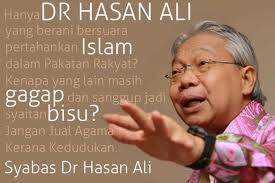
The strains have been there ever since. However, the controversy broke into the open earlier this month, with Kuala Lumpur’s pro-government mainstream media playing up comments by Hasan Ali, a member of the Selangor PAS executive committee saying he and his allies would seek to “bring the party back to the Islamic path," and claiming support particularly from Nasharudin Mat Isa, a former PAS deputy president who was supplanted by the new moderate team.

Later this week, Harun Taib, the head of the PAS Dewan Ulama, or council of religious leaders, announced it would support the two dissidents, who were called “fake members” by the party’s new mainstream leaders. Harun in turn, without naming names, called the Sabu faction “new immigrants who appeared to have no qualms deviating from the party's core principles.”

Both Hasan Ali and Nasharudin have been causing tension in the party virtually since the coalition took over the leadership of the state of Selangor in 2008 elections that shocked the Barisan Nasional. From his spot on the executive committee, Hasan sought to ban beer in the urban, relatively liberal state. He has also taken adamant positions against Christians. Both he and Nasharuddin paid for their conservatism during the June elections that brought Mat Sabu and his allies to power.

“Hasan Ali and Nasharuddin, who are at the centre of controversy and attacking their own party, lost badly in party elections last year, which means they have no support in their own party,” a Malay businessman told Asia Sentinel. “In fact, Hassan's actions against Christians and his banning of sale of beer in 7-11s in Selangor have been more damaging to the opposition than anything UMNO has done. If I were the opposition, I would be happy to see their backs. “

Although Hasan has claimed support from Nik Abdul Aziz Nik Mat, the party’s spiritual leader, other sources say he remains strongly allied with the modernizers.

“The factions within PAS have always been there, and they have come close to the surface several times in the past,” said a source with PKR. “They are appearing again now and much depends how it is handled. Nik Aziz’s official stand is important. It will of course affect the outcome of coming election if not properly handled and if the election is close.”

“PAS is doing some spring cleaning before the general election,” said another source, who described Hasan and his allies as “pro-UMNO elements” who needed to be cleared out and that “Once they’re gone, the coalition will be more consistent and stronger.”

Another neutral source called Hasan “essentially a lone ranger, and as such he has little grassroots support. But he does have some support within the leadership who are unhappy that the party is going soft on an Islamic state.” But, he continued, “When push comes to shove, they will stick with the party.”

Hasan himself stopped short of calling for PAS to pull out of the opposition coalition and told reporters that leaving the party and joining UMNO had never crossed his mind. But while that may true, it remains to be seen how the split will play itself out in the rural kampongs, or villages, particularly in the conservative eastern states, that traditionally formed PAS’s support base.

http://www.asiasentinel.com

Peaceful Assembly Bill Passed

The much-criticised Peaceful Assembly Bill was passed at the Dewan Negara today (December 20), merely 22 days after it was pushed through the Dewan Rakyat last month.

The Bill was tabled by Deputy Minister in the Prime Minister’s Department VK Liew in the afternoon and passed after nearly four hours of debates. Senate President Abu Zahar Nika Ujang allowed all senators to take part in the debate. However, only six BN senators and four Pakatan Rakyat senators offered their views.

The Bill was passed after bloc voting, with 39 senators supporting the new legislation that prohibits street demonstrations, while eight senators opposed it.

Bloc voting was requested by a Pakatan senator to record their discontent with the problematic law. UMNO senator Abdul Rahman Bakar quipped that the move was only a waste of time, and passed his “condolences” to those on the opposition bench.

During the debate, PKR senator Syed Husin Ali (left) retorted that the Bill overrides the provisions under the Federal Constitution as Article 10(1)(b) accords the people with the right to assemble peacefully.

He argued that although the legislative body has the powers to enact laws to restrict freedom, the Peaceful Assembly Bill is being mooted to completely wipe out the right to street protest.

“The constitution is the highest law in the country, all the laws should be subject to it,” he said, adding that the constitution is “weak” as it has been amended more than 170 times.

Syed Husin also took on the Police, accusing them of being the provokers during peaceful assemblies and rallies.

“They are the one who cause trouble (to the protesters),” he reiterated, citing the hullabaloo that transpired during the Bersih 2.0 rally on July 9 where the police were criticised for manhandling the participants.When the people are ready to disperse, only then will the police chase after them. This is the cause of the chaos,” he said.

Comparatively, in other democratic nations the Police would cooperate with protesters to facilitate the rally instead using force to disperse the gathering.

‘Bill necessary to curb untoward incidents’

Liew, who wound up the proceeding, picked on Syed Husin’s reference to Bersih 2.0, saying that it was Batu PKR MP Tian Chua who caused the melee in KL Sentral by “provoking the Police”.

Justifying the Bill, he said it is necessary to curb untoward incidents during an assembly.NONELiew (right) also picked on the walkout staged by Pakatan parliamentarians during the second reading of the Bill in the Dewan Rakyat, saying that they had missed an opportunity to debate the contentious law.

“They neglected their responsibilities as MPs, they chose to become MPs just to satisfy their political gratifications,” said Liew.

Coming back to the Bill, Liew insisted that as long as peaceful assemblies are confined to the designated places, after the law is gazetted there will be no need to seek Police permission first.

When the Bill was being contemplated in Parliament on Nov 29, members of the Bar Council, flanked by more than 1,000 supporters, marched demanding that the legislation to be withdrawn.

Others found a more unique ways to reject the bill by organising a series of flashmobs at the iconic Kuala Lumpur Twin Towers (KLCC). The activists have been consistently hosting the event every weekend and performing various acts - such as singing around the Christmas tree at the centre court of the mall and picnicking on the grounds.

Open Letter from India to Mahathir and UMNO

By Siddharthya Roy (12-14-11)

14 December, 2011

Dear Mr Mahathir,


A couple of days back I woke up to Indian newspaper reports which quoted you as saying that India's democracy is a hindrance to its development and if we did away with the nuisance of democracy we will be become developed (1).

Well Sir, it is heartening to see your concern about India's future. Especially now that our own elected government has orphaned us, someone from the outside caring about our development sounds so very nice. But you see Sir, your (apparently) good intentions notwithstanding, your advice to Indians is, well how should I put it...ill-advised. I'm not really sure if you know much about the history of our nation. Don't get me wrong.

Know Your Facts

Going by facts like the general absence of news from Malaysia's newspapers; the absence of anything but song and dance in your electronic media; the absence of bookstores that sell knowledgeable books (for example, the ones from which you can learn about history and not how to get rich in six steps); the abundance of malls and the stark absence of libraries; the abundance of coaching centers that can make masseurs, air hostesses and a host of quick fix technicians and the relative absence of centres of higher learning especially in the social sciences; and above all the fact that this insanely consumerist and hedonist Malaysia was made under your tutelage, makes me doubt your knowledge of the history of India or any nation for that matter.

Understand the Story of Indian Independence

So allow me to apprise you of the story of our Independence. We won Independence from colonial rulers waging a long and torturous battle. A battle that sought to replace a discriminatory, unjust and violent regime that had enslaved huge populations with one which was based on the principles of liberty, equality and fraternity.

India was home then, as is now and as will always be, to an immense diversity of people who spoke different tongues, prayed to different Gods, wore different clothes and had different political beliefs. These diverse people said to each other that - we, despite our differences, will strive to live and flourish together and make a sovereign nation which will be democratic, socialist and secular. We did not anywhere say that we want to be Malaysia or for that matter China or the USA.

India treats all its citizen as equal

We want to become a nation with a system that treats all its citizens as equal unlike your country that officially accords special rights to Malay Muslims calling them first class citizens while relegating thousands of people of Tamil, Chinese and other ethnic origins. Despite the fact that they have known no other land other than Malaysia as their own, you denigrate them with the tag of being second class citizens.

We try to work towards having a system wherein a person will grow according to his merit and hard work earning what he has rightfully earned. You may be surprised to know that here in India making cartels based on identity, even if under the name of bumiputra or son-of-the-soil, is called cartelisation and is looked down upon by most of us. Here promoting the selective interests of one's self or that of his kin is called corruption and nepotism and not, as you call it, development. We are in fact fighting tooth and nail to arrest the scourge of corruption and (you'll be shocked to know) get the guilty punished.

In India No One is Above the Law

Here in India no one is above the law and many a times powerful public figures go to jail for being corrupt or subverting the law. Now that we are at it, Sir, I'm sure it would be interesting to know what the minorities of you countries have to say - especially the jailed and beaten ones - about the development-democracy debate.

In fact Sir, your idea of development is largely at odds with many of us here. What you did to the tropical forests and water-bodies of Malaysia (that is raze vast acres of them into oblivion making way for big bucks palm oil plantations and piggeries and so on) would cause huge outrage amongst many of us who are looking for sustainable development.

We are yet to be unanimously convinced that making cemented roads - however broad, lining them with buildings - even if glass covered and glossy, putting cars on them - however fast they are-- is a substitute for our valued bio-diversity. Many of us are very convinced that displacing huge populations of native people for useless things like racing tracks is a blot on the word 'development'.

There are many of us who find it a shameful and cruel hypocrisy that in your country can have abundant openly advertised sex tourism and still whip women for being licentious! Thanks to the culture of reading here, many of us know of your penchant for cruelty in your personal career. A career during which you enacted despotic and violent acts at times in the name of (your contorted version of Islam) and at times in the name of security and national interest.

Malaysia's Internal Security Act, 1960

We could recount how you rose to power annihilating huge numbers of your opponents and stayed there for over two decades continuing yourdevious rule using tactics and schemes which are far beyond Machiavelli. Many of us know about your vile Internal Security Act 1960, which you used to crush political opposition jailing and killing them with impunity and putting in place a frail and near sham democracy placing the entire nation under a one man rule of the UNMO for over two decades.

You will note that in the essay above I have used words like "most of us" "many of us" and have tried to stay away form absolute claims. Besides the age old Indian practice of accommodating different opinions, it is meant to recognise that there are people in this country too who think like you and will have applauded you for saying what you did.

They too think that roads are all that are important and not the humans which walk on them or the ones that sleep beside them. They have misconstrued the word development as development of personal wealth and that this 'development' is a holy cow and everything including the rights and lives of fellow humans is a lesser priority. Their money power helps them buy a lot of print space and electronic bandwidth so they may appear like the majority, but thankfully the truth is they aren't.

The majority of us recognise and are willing to admit - and even discuss at length - that there are problems in our nation - including bad roads. But they'll quickly add that we intend to solve those not by lessening democracy but by increasing it.

1. Speech on December 2 Hindustan Times Leadership Summit in New Delhi

The author is a freelance writer and activist based in Maharashtra. siddharthyaroy@gmail.com

Tengku Razaleigh Hamzah on Victory, Consensual Leadership and Reversion to Form

I was recently asked to answer some questions for an Australian news programme:

1. Barisan Nasional has won several apparent victories over the Opposition in the last few weeks, but you have been critical of some of these. Could you explain why?

It depends what you mean by victory, and victory for whom. What happened in Perak recently has all the appearance of a desperate and ill-conceived grab for power, with constitutional consequences that are still being played out.

Barisan Nasional’s loss of popular support is the real issue, so our task must be to regain support.We really have lost support. March 8 was not a freak result. We have had two by-election losses, both of which were exacerbated by our own members abstaining, or voting for the Oppostion, to have that message drummed into the party leadership.

Victory would be to regain that support, and to translate those gains constitutionally into a stronger presence in the government. It would mean coming to terms with the true causes for our loss of support, and addressing those causes with real reform. Yet our leadership has done nothing of the kind over the last year. Instead we celebrate “victories” achieved by tricks and shortcuts liable to lose us even more ground with the Malaysian electorate.

These moves harm the long-term prospects of UMNO, and especially those of Barisan Nasional. However, they may serve candidates trying to secure their standing within the party in view of upcoming party elections. Weak leaders will pass off pyrrhic victories for the real thing, rally party members in the opposite direction from reform, and march them farther from the expectations and values of the Malaysian electorate.

No party can survive long with leaders who are so ready to sacrifice its viability for short-term and short-sighted political interests.

2. Some commentators speak of the need for BN and, particularly, UMNO reform, in particular a return to a more negotiated style of government. How far would you say UMNO has strayed from this consensus building mode of government, and how far is such reform necessary?

Consensual leadership is BN’s value proposition, if you will. If we lose this, we might as well close shop.

The negotiated power-sharing model that BN practiced successfully in the past requires a genuine partnership among the leaders of the various parties. It takes far more strength and ability to negotiate a consensus than to carry decisions by numerical dominance alone. As the dominant partner of this coalition, UMNO has a special responsibility of leadership in this process. It means we pick leaders with the ability and moral authority to mediate consensus and hold a moderate, pragmatic centre while maintaining an ethnic support base. This is something that cannot be done by weak or tainted leaders.

The consensus building model of government requires leadership formed in a tradition in which the skills and relationships needed to govern in this manner are consciously handed on. But the party succession is now dominated by ethnic champions or party warlords with little else to qualify them to govern a plural society with a sophisticated, trade-oriented economy.

There is also a structural reason for the incipient breakdown of our consensual model. For the model to work, each of the major ethnic parties must credibly and reliably represent its ethnic base. This is no longer the case. MIC, MCA, and now possibly UMNO, have each lost the majority support of the ethnic communities they claim to represent. The very raison d’etre of the model, and perhaps even of these parties, is at stake.

Nevertheless we still need this model of consensus-based government, helmed by a Malay leadership imbued with a sense of duty to Malaysia in all its plurality, East and West. The country still needs capable, centrist leaders who are also real leaders of the Malay and Muslim community, able to anchor and partner a multiracial and multi-religious consensus for a progressive country. At the outset this means a solid commitment to the rule of law which alone guarantees our form of government by constitutional monarchy and the rights and freedoms of all Malaysians. Umno is failing to provide this leadership but this does not mean we don’t still need it, and need it desperately.

3. Last week, the three contenders for the post of UMNO Youth chief held a live debate. Do you think these representatives of the future leadership are likely to embrace any necessary change?

Their individual records on that score have not inspired hope. None of them has presented a consistent and principled orientation towards reform. Some views expressed in that debate actually called for reversion to bad old form rather than for reform. If the party continues on its present recourse, the question would be moot.

Malay Rights v Special Position

by Stanley Koh

In this last week of 2011, we will be re-publishing selected stories carried in FMT throughout this year. We find that these stories still remain relevant in the present context.

FLASHBACK 2011

EDITOR’S NOTE: This story was posted on January 9, 2011, reminding the nation’s leaders the warnings that the late Tun Muhammad Ghazali Shafie gave 10 years ago. We think it is still worth reminding our leaders of his warnings.

“There are no Malay rights since our Constitution holds dear that all persons are equal before the law and entitled to equal protection of the law without discrimination on the basis of race and religion.”

That was what the late Tun Ghazali Shafie said in a speech at the National Unity Convention in May 2001. He continued: “What perhaps has come to be regarded as special rights is the special position of the Malays and natives of Sabah and Sarawak under Article 153 (of the Federal Constitution). The change from ‘position’ to ‘rights’ is frightening. Who did that, I wonder?

“In a plural society like ours, if the leadership was not bold and sincere enough to take corrective measures so that there would be a level playing field, then the situation would indeed be bleak and our society would be a playground for those who wish us ill.”

Born in Kuala Lipis, Ghazali was 88 at the time of his death in January 2010. He had a distinguished career in politics and government.Many bigots, opportunists and self-serving leaders of today will probably dismiss those remarks on the New Economic Policy as just one man’s opinion. If they are ignorant of history, they may even question his authority.

If Ghazali were alive and facing these critics, he would probably reply in these words, which were part of the speech at the 2001 convention:

"It was Tun Abdul Razak who asked me to devise the NEP after being inspired by Rukunegara. The NEP was the fruit of consultations among the various races in the Consultative Committee and later Parliament, who agreed to the corrective measures by invoking affirmative action.”

Distortions and Misinterpretations

In explaining affirmative action, he paraphrased Tun Dr. Ismail, who likened it to the handicap system in golf, “so that,” he said, “everyone could play together on a level playing field.”

He added: “Almost ad nauseam, it was explained that the NEP was not to make the Malay community rich but to change vocations through affirmative action. To acquire riches is the privilege of any individual and it would be contrary to the Rukunegara if the only aim was to make the Malays rich.”

When he spoke those words, the greed for riches through the NEP had long taken root. Distortions and misinterpretations of the policy had already divided the nation, and our so-called leaders tossed around the word “unity” only when elections were near, and they still do so today.

But unity, if we take it seriously, is indeed the key to resolving the profound problems that the nation faces.

Is “1Malaysia” a call for such unity? Many Malaysians do not think so. They believe instead that it is a red herring meant to deflect attention from the continuation of discriminatory policies.

The thinking public does not buy all the hype about 1Malaysia that BN is pushing through the media organisations it controls. It remains an empty and meaningless slogan.

And, as if oblivious of what the public is saying, 1Malaysia has become a favourite catchword among BN politicians. They tag the slogan to everything, like a chef sprinkling salt in every dish. Do they really think that Malaysians are stupid enough to believe that mere rhetoric can charm them out of their dissatisfactions?

Shifting goal posts

Tun Ghazali was right when he said that our national problem had become complicated because of the kind of education Malaysians were receiving. And nothing has changed since he made that remark 10 years ago.

“We become argumentative over some words without analysis or a look at the semantics,” he said. And Ghazali was right too when he said: “We don’t seem to care about the fundamental right to food and clothing.”

Critics accuse the UMNO-led regime of spending millions of ringgit on decorative rhetoric and ceremonial reforms without making any real effort towards substantive institutional changes that would bring about compliance with democratic principles and respect for human rights and needs.

Ghazali stressed that there could be no lasting unity unless the playing field was level. He added: “Let us not shift the goal posts when the field is beginning to level. This exercise at maintaining peace and stability must be kept in constant repair.”

Ghazali, once an UMNO Supreme Council member himself, probably had some faith that the party would eventually come to its senses and start to set things right again. If he were alive today, would he still have such confidence?

MACC Probe on NFC: Another Political Sandiwara in the Making?

by Wong Choon Mei, Malaysia Chronicle

Amid signs that Prime Minister Najib Razak's UMNO is fast unraveling, hit by massive graft and infighting amongst its top leadership, the Malaysian Anti-Corruption Commission has announced that a special team will be formed to investigate claims that UMNO Minister Shahrizat Jalil's family had squandered public funds allocated to the RM250 million NFC cattle livestock project on personal items and luxurious assets.

However, instead of appeasing public anger, all eyes are now on the drama at play in UMNO. While Shahrizat has hinted she was ready to quit, it is unlikely that she will allow herself to be railroaded or be made an easy scapegoat of by her own party mates.

All eyes are now on how Najib, himself the subject of a probe by the French government over allegations of having taken a 114 million euros or RM570 million kickback from French naval giant DCN for the purchase of 2 Scorpene submarines, will deal with the issue. Najib is also the UMNO President.

“Tell me, which UMNO leader does not have problem?” was Shahrizat's sharp retort when asked to comment whether she would heed the growing calls to resign, as reported in the Sin Chew newspaper a few days ago.

Lip service expected from the MACC

Indeed, public cynicism is inevitable given that the MACC had previously passed the buck to the police despite receiving reports from Opposition Leader Anwar Ibrahim's Parti Keadilan Rakyat.

The Najib administration lost further credibility when Deputy Inspector General of Police Khalid Bakar publicly declared there were no elements of criminal breach of trust during the recent UMNO General Assembly. Khalid, often called a stooge for the UMNO-led government, was accused of 'play-acting' in a bid to save the UMNO leaders embarrassment.

"We have acted accordingly by collecting evidence and statements since the issue was reported in the Auditor-General's Report. A large part of the issues brought up in the latest complaint (against NFC) had already been acted upon,” a defensive-sounding MACC investigations director Mustafar Ali said in a statement released on Thursday.

The MACC was also quick to stress it could not divulge details of investigations as stipulated under Section 29(4) of the Malaysian Anti-Corruption Commission Act 2009. “We call on the parties to give their full co-operation by not politicising the issues which could affect our investigation,” Mustafar added.

Given the tone of the statement, it was clear to political watchers that the MACC was not going to do much to uncover the dirt in NFC or National Feedlot Centre, a project aimed to raise local supply of beef to up to 40% of consumption and keep prices affordable.

The project was awarded to Shahrizat's husband, Salleh Ismail, and her children in 2006 by then then Agriculture minister Muhyiddin Yassin on the prodding of UMNO Youth Chief Khairy Jamaluddin, the son-in-law of former premier Abdullah Badawi. Najib also played a part in approving the project to Shahrizat's family.

Another shameless sandiwara

Cynicism is high that this was the latest 'sandiwara' or drama enacted by UMNO to tell Shahrizat to quit her Cabinet post and take responsiblity before general elections are held next year.

No one is expecting any major change in the attitude of the top UMNO leaders, who are renowned for their corruption-tainted records - as Shahrizat herself alluded to.

"Both Shahrizat and UMNO are shameless. The issue is why such a loan was given to her family when she was holding the position of a Cabinet minister. It is impossible they could have got the loan if she were not a minister. She and her family have deprived needy and hardworking Malaysians from the benefit of the fund (meant to supply everyday Malaysians with a cheap source of beef)," PKR vice president N Surendran told Malaysia Chronicle.

"It is also pointless to blame Shahrizat alone. UMNO bears the biggest blame. Benefiting cronies and families from public funds is a central part of UMNO's political culture."

Victim of the Mahathir legacy of corruption?

Furthermore, those who have called on her to quit before she is "chased out" include former premier Mahathir Mohamad, notorious for defining and expanding UMNO's feudal system of politics where the ruling elite have carte blanche over almost every aspect of economic and political life in Malaysia.

In the recently released Global Financial Integrity report, Malaysia was identified to be the 4th most corrupt nation in the world, racking up a total of US$338 billion (RM1.08 trillion) in illicit outflows over the first decade of the century.

GFI also said the Malaysian increase was “at a scale seen in few Asian countries.” In January, it had reported that RM930 billion flowed out of Malaysia from 2000 to 2008, growing to RM218 billion per year from an initial RM71 billion in that period.

“This report should be a wake-up call to world leaders that more must be done to address these harmful outflows,” GFI director Raymond Baker said in a press release.

Upon release of the GFI's report in January, it was telling that one of the first UMNO leaders to cast doubt on the renowned Washington-based body was Mukhriz Mahathir, the youngest son of the former PM. Now 86, Mahathir had ruled Malaysia for 22 years and is widely believed to be the one who has salted away the biggest fortune at taxpayers' expense.

Malaysia Chronicle

Khir Toyo says that he was not charged with taking bribes

by Malaysiakini (12-27-11)

Former Selangor Menteri Besar Dr Mohd Khir Toyo today stressed that he was not charged with taking bribes, as alleged by his opponents.

“I know many who don’t like me are spreading word that I (was convicted for) taking bribes. In reality, I was charged under Section 165 of the Penal Code, which reads that I had obtained something without adequate compensation from someone who has an official relationship with me,” said Khir in a blog posting today.

NONEKhir was sentenced to 12 months’ jail on December 23 after being found guilty by the High Court for obtaining for himself and his wife a luxury mansion at a consideration he knew was inadequate.

Justice Mohtarudin Baki also ordered the confiscation of the said property under Section 36 (1) of the Anti-Corruption Act 1997. A stay of execution for both penalties was allowed pending appeal.

In his judgment, Mohtarudin said the RM3.5 million which was paid by Khir for the property was “inadequate consideration” and “it was clear the accused was interested in the properties much earlier”.

The judge ruled that the prosecution managed to establish a prima facie case on the essence of their charge against Khir, which was, as a public servant he obtained something valuable through Ditamas Sdn Bhd director Shamsuddin Hayroni for a consideration he knew was inadequate.

Meanwhile, Khir wrote on his blog that he cannot comment on the judgment because the matter will soon be brought to the Court of Appeal. “This is a legal process and (my quest) for justice has not ended,” he said.

He said that although he cannot comment on the matter, he expressed gratitude to bloggers who had covered his trial fairly. “I believe that even if I don’t obtain justice in this world, I will have justice when I meet my maker,” he said.--www.malaysiakini.com

HRF report to Washington: Institutional Racism in Malaysia

Human Rights

report-us

CPI introduction

Below is the executive summary made by P. Waytha Moorthy, the founder of Hindraf and leader of the Human Rights Foundation Malaysia. Also uploaded is the paper presented before the US House Committee on foreign affairs and the Tom Lantos Human Rights Commission.

According to its brief, "Human Rights Foundation Malaysia is an organisation dedicated to the protection and promotion of Human Rights for the marginalised in Malaysia. We document and report all forms of violations, give voice to the oppressed and hold the Government accountable for its Human Rights violations. We lobby International support for the marginalised community and submit Independent reports and evidence to International bodies.”

Institutional Racism and Religious freedom in Malaysia

Executive summary
  • Institutional racism is the process by which people from ethnic minorities are systematically discriminated against by a range of public and private bodies. If the result or outcome of established laws, customs or practices is racially discriminatory, then institutional racism can be said to have occurred.

Dr.Benjamin Bowling

(Professor of Criminology & Criminal Justice and Director of Criminological studies in the School of Law, King's College London.)

  • Malaysia has all the hallmark of a racist and religious extreme state on the following foundation;

a) The Federal Constitution entrenched with a racist provision vide Article 153 ( Malaysian brand of apartheid)

b) The State sanctions racist and religious extreme laws and policies

c) State control of Government Administration by 1 race/religious group

d) State channel of most funds for economic/education/development programs and licenses, permits ect to 1 race

e) State control of Religious freedom to disadvantage of non-Muslims, imposition of Muslim religious laws and compelling jurisdiction of Syaria Courts on non-Muslims.

f) State sponsored violence/threat of violence both directly and outsource to other groups on objections by citizens

g) State sanction of draconian, punitive laws and the blank cheque given to Police to make arbitrary arrests on dissent.

h) State declaration that the Malays are the masters (Malay Supremacy) and sons of soil.

  • Ethnic groups in Malaysia : Malay 53.3%, Chinese 26.0%, indigenous 11.8%, Indian 7.7%, others 1.2%.

  • Religions: Islam (60.4%), Buddhism (19.2%), Christianity (9.1%), Hinduism (6.3%), other/none (5.0%). - US Department of State 2011

  • Malaysia is a country based on a subtle, pervasive and increasingly aggressive form of racism. The conflict that lies just below this artificial calm state, is so well concealed, that to someone with just a cursory knowledge Malaysia would find it hard to believe and this is part of the problem.

  • Malay supremacy or Malay dominance is the claim that the Malay Muslims are the tuan (masters) of Malaysia. The Chinese and Indians, who form a significant minority in Malaysia, are considered beholden to the Malays for granting them citizenship in return for special privileges as set out in Article 153 of the Malaysian Constitution.

  • Article 153 is a deep-rooted racist provision in the Constitution which sanctions implementation of all racist policies in Malaysia to the disadvantage of the minority non-Malay/Muslim population. Questioning any matter, rights, status, privilege ect of Article 153 is considered a challenge to the Malay Supremacy, insulting the Royal Institution and Islam. It is also deemed a threat to National Security, an offence under the Internal Security Act which gives powers of arrest for unlimited period without trial and under the Sedition Act which provides for imprisonment between 3-5 years.

  • Since the Democratic uprising of Hindraf in 2007 and the subsequent loss of its 2/3 Parliamentary mandate in the March 2008 elections, Government has outsourced its overt racist agenda to NGO’s in particular PERKASA. This is an NGO led by a Pro Government Parliamentarian who promotes the Malay Muslim supremacy agenda and has the explicit support of top Government leadership including the former Prime Ministers, ex- Army officials and ex- Inspector General of Police.

  • PERKASA works intimately with a more militant group known as Pekida and another underworld Para- military group known as 3 LINE. Together they perpetuate racial hatred and cause fear among the non-Malays.

  • Government budgetary allocations.

  1. All Government projects are primarily given to Malay Muslim Bumiputra individuals and organizations.

  2. All Government contractors have to be licensed by the Finance Ministry before being given any Government projects.

  3. Malays have been promoted in the Civil service to assure that the highest policy-making positions will be filled by Malays regardless of objective performance standards.

  • As of June 2005, more than 85% of the Civil Servants were Malay Muslims. This was an increase of close to 25% from 1971.

  • The FELDA Scheme – Federal Land development Authority

  • There is a systematic and wholesale exclusion of Non-Malays from this program. Indian plantation workers who were being actively displaced at the time of the growth of this FELDA scheme in the 1970s and 1980s were not considered part of the target group, because they were not categorized as being from the rural community. This was convenient way to exclude. An estimated 800,000 Indian plantation workers have been displaced from plantations without any alternative programs/compensation.

  • FELDA, FELCRA, PERDA, KEDA, KETENGAH, KESEDAR, KEJORA and a host of other development agencies use procedural techniques of one form or another such as this to entirely exclude the deserving non-Malays.

  • FELDA show a total turnover of RM 11.8 Billion. The profits before tax alone are RM804 million.

  • A RM 120 million residential school for FELDA children - a Maktab Rendah Sains Mara (MRSM) in Trolak, Perak. Compare this with the recent promise of an allocation of RM100 million by the Prime Minister for 523 Tamil schools in the country, for which there is no evidence of disbursement anyway. There are 42 MRSM schools like the one above in the country.

  • In 1980, the World Bank raised concerns over the ethnic bias in FELDA settler selection by pointing out that if the government was serious “about increasing the non-Malay share in agriculture, some increase in the non-Malay share of settlers was warranted

  • The Tekun Nasional scheme is a scheme to provide micro credit and to develop majority Malay Muslim entrepreneurs.

  • For the year 2008 alone TEKUN Nasional has provided RM 182 million as loans to 19,000 entrepreneurs.

  • That is close to RM1 Billion -not to mention almost all those loans went to Malay Muslim entrepreneurs. Participation in the Tekun program of Indians is miniscule - a total of 93 Indian entrepreneurs received loans amounting to RM761,000 on July 24, 2009 in a ceremony.8 That is less than 0.1% of that disbursed to the Malay Muslim entrepreneurs.

  • The collusion of the various arms of the Government to keep dissent in check.

Some of the key ones are :

1. Government Linked Companies

2. Government Investment Companies

3. Economic Planning Unit

4. The Federal Cabinet of Ministers

5. The various Ministries

6. The Royal Malaysian Police

7. The Attorney general’s Office

8. The Judiciary

9. The Government Administrative Services

10. The Government owned Banks

11. The Government controlled media

  • The Government has used suppressive laws like the Internal Security Act, the Official Secrets Act, Printing Presses and Publications Act, the Seditions Act during this period to implement these terribly racially lopsided development plans while allowing the racist system to grow

  • Given the need to maintain a racist regime, the Police have become a primary instrument of control for the majority Malay Muslim party in Government –UMNO. Police violence, abuse of power and human rights abuses occur very regularly. Cases of death in custody, partial handling of criminal disturbances, violent dispersal of peaceful protestors and other form of human rights violation continue. This has created a climate of impunity and normalization of violence, abuse of power and violation of human rights in Malaysia.

  • More than 77% of the Government administration members are of Malay Muslim ethnicity. About 20% the Indian members and about 60% of the Chinese members of the Government administration are teachers in the Government Vernacular schools. If they are excluded from the numbers employed by the Government administration, the picture that emerges is about an overall participation of 85% Malays in the administration.

  • The Malay Muslim employees of the administration go through special programs of training called National Civics Bureau where they are all educated on how to keep “the wealth of the family within the family” in short how to operationalize the racist policies of the Government. This is a much criticized activity, but the Government continues with impunity as it is a key approach in recreating that racist bureaucracy.

  • The Mainstream media blocks out, demonizes and distorts information of any organization that speaks out against this racist system in a coordinated fashion. The Government uses the Printing Presses and Publications Act and limiting ownership to known allies to control the Media to do this.

  • There are an estimated 150,000 – 200,000 Indian children who are stateless due to the States’ reluctance to recognize them as Malaysians. This is operationalized by the racist state bureaucracy. As result they are not admitted in Schools, enjoy health care and other benefits a child enjoys.

  • The racial bias in the educational system is the area where racism is most blatant – all the way from pre-school and primary education up to Tertiary levels.

  • There are 42 fully residential elite Maktab Rendah Sains Mara (MRSM) (Mara junior Science College) (NST 5/4/08) with 12,440 places also in the fully residential schools (BH 21/11/09 at page 7). These schools have been almost exclusively for Malay Muslim students

  • Non-Malays are also almost 100% excluded in other elite schools like the Royal Military College, Aminuddin Baki Institution, Matriculation courses and the Malay College Kuala Kangsar.

  • There are two streams for entry into the Public Universities. One is through the Matriculation 12 month program specifically tailored for the Malay Muslim students and the other is through the 18 month and much more stringent STPM program

  • Admissions into public Universities is more than 80% reserved for the Malays Muslims. One university with a student population of 170,000 in 2011(UiTM) is for Malay Muslims only. The other 19 public Universities with about 170,000 enrolments in all have a 60% Malay Muslim students making it 80% for Malay Muslims in all Public Universities. This does not even talk about the composition in the various courses offered.

  • There are 62,000 diploma places and 60,000 degree places for 2010 at 27 Polytechnics in Malaysia. These are exclusively for the Malay Muslim students.

There are 163,779 students studying at the 19 other Public Universities nationwide at an annual expenditure cost of RM 2.6 Billion15. Our estimate is a mere 5 % of this expenditure will accrue to non-Malay students.

  • RM 2.8 Billion is allocated for the 2010 National Budget for student’s assistance scholarships. Most of the funds go for scholarships to Malay Muslim Students.

  • 1,266,671 students (estimated 90% Malay Muslims) have benefited from the government PTPTN (Government Higher Education Loan Fund) study loans till 2009. 147,441 such loans were approved at RM 17.0 Billion (UM 25/3/08 at page 31).

  • The constitution provides for freedom of religion; however, the constitution and the government placed restrictions on this right. The constitution defines all ethnic Malays as Muslims at birth and stipulates that Islam is the "religion of the Federation."

  • Civil courts continued to concede jurisdiction to Sharia courts on cases concerning conversion from Islam and certain areas of family law involving disputes between Muslims and non-Muslims.

  • Forced religious conversions and religious intolerance are evidence of creeping Islamization in Malaysia. Whenever there is a conflict between Muslim and non-Muslims, the tendency is for Muslim Laws to prevail over the non-Muslim issues regardless of the merits of the case.

  • The decision of the Court of Appeal on 21st August 2010 in the case of Maniam Moorthy is a disturbing trend in the role of the Judiciary which has abdicated its powers to the inferior Sharia Courts which was meant to serve the Muslims only on matters (personal) pertaining to marriage, divorce, property distribution ect.

  • Lina Joy, 42, who was born to a Malay Muslim couple, became a Christian when she was 26.

  • She lost her final round of appeal when the Federal Court dismissed her appeal on 30th May 2007 against a ruling that the National Registration Department was right not to allow her to remove the word "Islam" from her identity card.

  • In August 2010 The newspaper of the Catholic Church in Malaysia, The Herald, filed a legal suit at following warnings that its permit could be revoked if it did not cease use of the word "Allah" in the Malay language section of its newspaper.

  • Several Malaysian churches have been attacked and fire bombed, leaving at least one badly damaged, in an escalating dispute over the use of the word "Allah" by Christians.

  • A religious edict (fatwa) by a Muslim cleric in the state of Sabah caused the Sabah state government to cancel the construction of a 108 feet Goddess of Sea Mazu statue by the Taoist in 2008.

  • In August 2011 The Selangor Religious Department raided a Church dinner function organised by an NGO on allegation of Christian proselytizing campaign.

  • According to the government, it allocated 428 million ringgit (approximately $125.9 million) to build Islamic places of worship and 8.1 million ringgit ($2.4 million) to build Christian, Buddhist, Hindu, and other minority religions' places of worship between 2005 and the end of 2008. (in answer to a Parliamentary question)

  • Throughout the years since Malaysian independence in 1957, the government has been disregardful of the systematic destruction of Hindu places of worship, which previously stood on estates and state owned estates and land. An estimate of about 10,000 Hindu places of worship have been demolished.

  • The government justifies the demolition of the places of worship on the grounds that they were illegally constructed or were occupying government land. Planning and building laws never existed at the time of the construction of these places of worships.

Conclusion

Promoting freedom and democracy and protecting human rights around the world is central to U.S. foreign policy and consistent with the values upon which the United States was founded. The Malaysian minorities long to live with dignity and freedom but are denied dignity and freedom by a racist regime that has developed over the last 50 years in the name of affirmative action for the majority. The endless extensions of the affirmative action policies have now led to serious Human Rights violations of the minorities in the country. This is inconsistent with developments around the world and with the aspirations of the minorities of Malaysia.

It is time for the international community to hold the Malaysian government accountable for this performance. The world has to wake up to these developments in Malaysia, for the future of this trajectory is being told many times over, in what is happening around the world today.

http://english.cpiasia.net/index.php?option=com_content&view=article&id=2272:hindraf-report-to-washington-institutional-racism-in-malaysia&catid=78:Human%20Rights