Wednesday, February 23, 2011

Heirless’ Taib is afraid to step down

Mohd Ariff Sabri Aziz | February 23, 2011

Chief Minister Taib Mahmud is desperately in need of a political successor to safeguard his and his family's empire in Sarawak.

I have regular meetings with the someone whom I would like call the “Oracle of Syed Putra.” I first started penning my meetings with the Oracle way back in 2008 in my blog.

The “Oracle” is the alter ego of Tun Daim Zainudin. They grew up together. They knew each other’s siblings. They played together and did things normally done by the young and old alike. They were inseparable.

I already had an appointment with the Oracle, when I saw Daim’s picture in The China Press. I called M, the Oracle’s long-time personal assistant, and asked if he could get the Chinese report translated. There would have been a translated transcript for the Oracle. The Oracle must be a keeper of sorts for Daim. He is a treasure trove.

Anyway I got the translated copy on the day of my meeting with the Oracle.

Knowing that I can be fastidious about the written language, M quickly pointed out “that’s the English translation done by the Press people. That’s not the English of the Oracle or Tun Daim.”

I ran through the translated copy. It contained many things that I had written about in my blog sakmongkolak47 since I began my regular sitdowns with the “Oracle of Syed Putra”.

The Oracle once told me that Daim reads my blog.

Rosmah-link

Anyway, when my time came, I entered into the Oracle’s inner sanctum. I immediately asked about Sarawak.

Question: What is your take about Sarawak, O Oracle?

The Oracle: You know what’s the problem with Toib? (Incidentally, the Oracle has this peculiar way of pronouncing the name. The Oracle comes from Kedah. The way they pronounced Taib is Toib – the “T” is the “tho” of the Arabic alphabet. Hence “Taw-ib”.)

He (Taib Mahmud) wants to stay as long as possible because he hasn’t got a succession plan. He knows he is breeding an uprising in Sarawak. He wants the son to succeed. But the son seems to have lost all interest since the mother passed away.

You remember the Islamic Fashion Show in Monaco? It was bankrolled basically by Taib’s people. The whole soirĂ©e was financed by Taib. It was his way of getting into the good books of Rosmah (Mansor).

So he got some Sarawakian fashonista who talked to that Raja Shahreza (organiser) fellow who talked to Rosmah (Prime Minister Najib Tun Razak’s wife) and who talked to… and they all got to sing along with Prince Albert, the Playboy of Monaco.

And do you remember after that, the PM came back and urged all parties concerned to support Taib. Even though earlier, he thought it was time for the silver-haired one to go.

Now he’s trying to persuade Najib to hold simultaneous parliamentary and state elections. For that he sends his sister to bond up with Rosmah.

Everyone now seems to realise that it’s Rosmah who exerts paramount persuasive powers over the husband. And the husband is the PM of Malaysia.

Self-presevation

Taib’s reasoning is, if elections were to be held at the same time, the opposition’s forces and resources will be thinly spread. That way, he can be more certain Sarawak will prevail.

And by suggesting that the fortunes of the federal government are tied to how Taib performs in the state elections, Najib may just be persuaded.

Everyone knows that Najib has got this phobia. Tell some scare stories and he will wilt.

You know, TDZ (Daim) met up with this Taib feller. He tells the latter, it’s time to go. Mahathir has left. Ling (Liong Sik) has left. You may be overstaying. Taib tells Daim that he needs time to plan for a succession.

Why is the right succession important?

It’s essential for self-preservation. Taib practically owns the whole of Sarawak. If some wrong person were to get into office, can his interests be protected? Can the future of his children be guaranteed?

He needs someone who can guarantee safety over his interests and the future of his family.

Succession plan

I went on to the next question. It’s itching and eating me up.

Question: When do you think he will hold the Sarawak election? Will it be done concurrently?

(The Oracle): Not good. Better to have it done separately. Taib will lose many of the urban seats. The Chinese are not going to vote for the BN. Do you think the Chinese will get intimidated by Taib’s warnings that he won’t be able to help the Chinese? Certainly not.

The Chinese help themselves basically. The lesser you interfere, the better they like it. They can run a parallel economy, you know.

The best strategy for Najib is to carry out a containment policy. If Sarawak were to lose more state seats this time, let that losing trend be contained there. Don’t let them get over here in peninsula.

The biggest problem in Sarawak is Taib himself. He has stayed too long and accumulated too much resentment alongside the fabulous wealth that he has amassed. Sarawak can lose more seats based on the public revulsion of him alone.

It’s like the flow of current. You hold hands with a man about to be electrocuted, you get zapped too.

Najib will be ill advised if he holds the general election together with the Sarawak election.

Mohd Ariff Sabri Aziz, a former state assemblymen, is a columnist for Free Malaysia Today. He will, from time to time, share the Oracle’s wisdom with readers.

Tuesday, February 22, 2011

Sarawak: Shocking New Cases Of Violence Against Indigenous Peoples In Sarawak

HSBC-funded oil palm company hires gangsters to intimidate native landowners - Two native landowners critically hurt by timber company officials

BLD Plantation Bhd, a Malaysian oil palm company that counts HSBC Malaysia among its principal bankers, has hired over 100 armed thugs to intimidate native landowners who are opposed to the forceful "development" of their land into an oil palm plantation.

According to the Borneo Resources Institute Malaysia, around 100 armed gangsters had been brought in two buses from Sibu to Rumah Ranggong on 17 February in an attempt to intimidate the longhouse residents. The gangsters had brought along parangs (large knifes) and some explosives. Fearing for their safety, some of the longhouse residents reported the case to the police who arrested the gang leader and sent the rest away. The longhouse people had been defending their lands against an oil palm development by Niamas Istimewa, a BLD subsidiary. BLD plantation is part of the KTS group that is also active in Indonesia, China, Brazil and Australia.

In a separate, even more shocking case, two native landowners, Minggat Nyakin and Juan Minggat, were beaten up on 14 February at a timber log-pond in Sungai Rusa, Sarikei Division. According to Sarawak's indigenous peoples' network, TAHABAS, the two had been complaining against illegal logging on their native lands with the timber company manager. It appears that the illegal loggers are being protected by the police and the Sarawak authorities. The case is symptomatic for the culture of corruption and the lack of law enforcment in the Sarawak timber and plantation sector.

Source: Borneo Resources Institute Malaysia

Related Articles, Videos, Books, Or Other Items

Who Are The Aggressors?

Who Are The Aggressors?

22 February, 2011
By Lord Bobo
Arrested Gang Leader | Credit: BRIMAS

Arrested Gang Leader | Credit: BRIMAS

On the 18th Feb, 2011, 100 armed thugs camped at Rumah Ranggong, Sarawak with explosives & parangs, over a land dispute with an oil palm company. Now the villagers are being accused as the aggressors by the local press.

MIRI - Residents of Rumah Ranggong are disappointed with the news report from a local daily, the Borneo Post which portrayed them as the aggressors and are out to threaten the company, BLD Resources with the use of force.

On 20 February, the Sunday Post under the headline "Police finally move to diffuse standoff" was reported as saying that the longhouse residents were taking over the estate, illegally harvesting of (oil palm) fruits along the roadside and eventually seizing three tractors in order to harvest more fruits.

The report also stated that the longhouse residents allegedly threatened the workers of the company with bodily harm if the company continue to lodge police reports and because of that the report further state that the estate’s security personnel was inadequate and therefore are sending more men to beef up the security in the area.

Gangsters Camp or Security Personnel? | Credit: BRIMAS

Gangsters Camp or Security Personnel? | Credit: BRIMAS

Changgai anak Dali, the Chairman of the village security and development committee (JKKK) said that this report is a blatant lie.

"We never seized any tractors nor threatened the company," said Changgai.

"It is the company that brought along gangsters fully armed with machetes and explosives to intimidate and threatened our longhouse people," he said.

Explosives Found | Credit: BRIMAS

Explosives Found | Credit: BRIMAS

"Why should security personnel bring along with them home made explosives? Who is threatening whom here with force?" asked Changgai.

The report also lied when it said that the longhouse residents, through their trustees had signed an agreement of indemnity with the company for the equity of 30 percent in July 2009 when in actual fact the Joint Venture Agreement (JVA) between BLD, Sarawak Land Development Board (SLDB) and the native landowners of Rumah Ranggong and Rumah Belilie was signed in February 2001.

Two Boxes of Parangs From The Camp Were Seized by Police | Credit: BRIMAS

Two Boxes of Parangs From The Camp Were Seized by Police | Credit: BRIMAS

On 21 February, the Borneo Post under the headline "Police to take action over alleged threat" again spun the story to paint the picture that the residents of Rumah Ranggong are the aggressors by saying that several longhouse folk had allegedly threatened to use force against the company.

"We want to put the story right here," said Changgai.

Deed of Rescission | Credit: BRIMAS

Deed of Rescission | Credit: BRIMAS

"In October 2008, a Deed of Rescission (see attached) was signed between SLDB and BLD without our knowledge to rescind the JVA because the State Government made a mistake in declaring our land as under native customary right (NCR) and now it is State Land," said Changgai.

"Because of this I was sued by BLD for trespassing in my own land and that triggered our land dispute where we filed a counter suit which is now undergoing trial at the Kuching High Court."

More Explosives Found & Seized | Credit: BRIMAS

More Explosives Found & Seized | Credit: BRIMAS

"Last year we wrote a letter to BLD to demand our land back and also to settle our long overdue dividends from the project, but we received no response and that is when we decided to erect our blockade in January this year," explained Changgai.

The neighbouring residents of Rumah Belilie also erected a blockade to protest against BLD.

Last Friday, about 100 armed gangsters went to the outskirts of Rumah Ranggong native customary land boundary and made camp there in an attempt to intimidate and threaten the longhouse residents. A gang leader was arrested by police while the rest were told to leave by the police.

Released by:
Mark Bujang
Executive Director

For more information, please read:
1. Malaysia: Trial of Ibans from Rumah Ranggong started at Kuching High Court
2. Sarawak: Ulu Niah Natives Set Up Blockade Against Company For Not Keeping Promise
3. Sarawak: Ulu Niah Natives Erect Another Blockade Against Plantation Company
4. Thugs arrested after threatening longhouse folks [thestar.com.my]
5. Associations: All parties must learn from Niah standoff [thestar.com.my]
6. Near clashes between gangsters and natives [freemalaysiatoday.com]

Monday, February 21, 2011

EXCLUSIVE: Taib's secret foreign assets black list is online

EXCLUSIVE: Taib's secret foreign assets black list is online

EXCLUSIVE: Taib's secret foreign assets black list is online

Built with laundered timber corruption money: Taib towers in Ottawa, Canada

BASEL (SWITZERLAND) / KUCHING (MALAYSIA). The Bruno Manser Fund has today released a black list of companies related to the family of Abdul Taib Mahmud, the long-serving Chief Minister of the Malaysian state of Sarawak. The black list contains the names and company numbers of 49 companies in eight countries which are thought to be worth hundreds of millions, if not billions, of US dollars. A considerable number of the companies is active in the real estate and property sector.
The exclusive black list can be accessed under: stop-timber-corruption.org/resources

Taib Mahmud, who has been Chief Minister, Finance Minister and State Planning and Resources Minister of Sarawak since 1981, has an impressive track record of corruption and abuse of public funds. According to the Democratic Action Party (DAP), Taib has failed to account for a staggering 4.8 billion Malaysian ringgits (1.58 billion US dollars) of Sarawak state funds over the past three years alone. In 2007, the Tokyo tax authorities uncovered a massive corruption scheme that involved the payment of kickbacks to the Taib family. In return, nine Japanese shipping companies had received export licences to carry logs to Japan, Sarawak's largest timber export market.

The black list names 13 Malaysian companies, 10 Australian companies, 9 Canadian companies,7 Hong Kong companies, 4 US companies, 3 companies on the British Virgin Islands and 1 company in Jersey. Among the companies listed are Sakto, a significant Ottawa-based property developer, Ridgeford Properties, a London property company active in the high-end market, and Wallysons, the owners of the FBI Northwestern Regional Headquarters building in Seattle. Among the Malaysian companies, Cahya Mata Sarawak (CMS), the state's largest private company, and the Ta Ann logging group are most notable.

The black list's intention is to help the listed countries' anti-corruption and anti-money-laundering authorities identify and freeze illicit Taib assets in their countries. The list will be regularly updated.

(21 February 2011)

EXCLUSIVE: The black list of Taib’s secret foreign assets

EXCLUSIVE: The black list of Taib’s secret foreign assets

The following companies are, or have been, closely linked to the family of Abdul Taib Mahmud ("Taib"), who has been Chief Minister of Sarawak, Malaysia, since 1981. Taib's ill-gotten foreign and domestic assets are estimated to be worth hundreds of millions, if not billions, of US dollars.

The Bruno Manser Fund and thousands of supporters around the globe are urging the authorities of the below-mentioned countries to investigate the financial transactions of the black-listed companies under their respective anti-corruption and anti-money-laundering legislations and to freeze all Taib family assets for later restitution to the people of Sarawak.

Australia: Australian Universities International Alumni Convention Pty Ltd (ACN: 081942903); Donmastry Pty Ltd (ACN: 093 907 843); Geneid Holdings Pty Ltd (ACN: 087759751); Golborne Pty Ltd. (ACN: 061844148); Golden Sovereign Development Ltd (ACN 103 925 613); Kesuma Holdings Pty Ltd. (ACN 105540636); Newtop Holdings Pty Ltd (ACN: 066588225); Ostgro Australia Pty Ltd (ACN: 094721070); Sitehost Pty Ltd (ACN: 062312743); Valentine on George Pty Ltd (ACN: 105541562)

British Virgin Islands: Astar Properties Ltd. (201522); CMS Global (BVI) Ltd.; Tess Investments Ltd (203511)

Canada: Adelaide Ottawa Corporation (2028546); City Gate International Corporation (446027-8); Glowell Development Corporation (1545868); Preston Building Holding Corporation (2108122), Sakto Development Corporation Pte. Ltd. (155207-4), Sakto Corporation (340439-1), Sakto Management Services Corporation (655948-4), Tower One Holding Corporation (2028542), Tower Two Holding Corporation (2018543)

Hong Kong: Grand Shine Trading Ltd (0127665); Grand Will Ltd (0133932); Herolite Investment Ltd (129119); Natalite Investment Ltd (129502); Regent Star Company Ltd (0130318); Richfold Investment Ltd (0130308); Whittaker Company Ltd (0161304)

Jersey: Sogo Holdings Ltd (43148)

Malaysia: Achi Jaya Holdings Sdn Bhd; Borsarmulu Resort Sdn Bhd (213014-M); Cahya Mata
Sarawak Sdn Bhd (21076-T); K&N Kenanga Holdings Bhd; Kumpulan Parabena Sdn Bhd; Mesti
Bersatu Sdn Bhd (758849-V); Naim Holdings Berhad (585467-M); Sanyan Group; Sarawak
Aluminium Company (783974-K); Sarawak Energy Bhd.; Ta Ann Group; Titanium Management
Sdn Bhd; UBG Berhad (240931-X) United Kingdom: Ridgeford Consulting Ltd (5572163); Ridgeford Properties Ltd (3268801)

USA: Sakti International Corporation Inc.; Wallysons Inc (the owner of the FBI building in
Seattle!); W.A. Boylston Inc; W.A.Everett Inc.

This list has been established on 21 February 2011 and will be regularly updated.

For more information, please consult our campaign site http://www.stop-timber-corruption.org

Saturday, February 19, 2011

People’s Call for Regime Change - Part 2

18 February, 2011
By NH Chan
Photo Credit: Wan Eijas

Photo Credit: Wan Eijas

The People’s Judge continues his call to the young to use the tools of modern communication to effect change in Malaysia, pointing out how we are stuck with a government using 19th century British colonial laws to further repress us. Read Part 1 of this article here.

The Sedition Act as applied in this country

The sedition legislation is the most oppressive law ever devised by a colonial power to subjugate the natives by the colonialists who took over the land they had colonized. In this country the Sedition Act 1948 is typical of such colonialism - this word means ‘the practice of acquiring and controlling another country and occupying it’. If you read on you will know that this is the true picture of how our Sedition Act 1948 migrated from 1870 British India to Peninsular Malaya in 1948 when the country was a British protectorate except for Malacca and Penang which were colonies.

There is an excellent article in the Star, Wednesday, 9 February 2011, titled Sedition law’s overreach by Professor Shad Saleem Faruqi. It says:

Definition: Section 2 and 3(1) of the [Sedition Act 1948] state that any act, speech, words or publication are seditious if they have a tendency towards any of the following:

To bring into hatred or contempt or to excite disaffection against any Ruler or government.

Dissaffection does not mean absence of affection but refers to disloyalty, enmity and hostility: PP v Param Cumaraswamy [1986] 1 MLJ 526

Application of the law: In Param Cumaraswamy it was held that intention to incite to violence, tumult or public disorder is not a necessary ingredient of the crime.

As long as the words were intentionally published and they had a tendency to cause ill will, etc, the offence is complete.

The Professor also alluded to the acquittal of Mr Cumaraswamy:

But in PP v Param the defendant’s criticism of the Pardon’s Board for not applying uniform standards in considering applications for mercy was held not to constitute sedition.

I was the judge who tried Mr Param Cumaraswamy. At the conclusion of the trial, I acquitted him.

As pointed out by Professor Faruqi ‘As long as the words were intentionally published and they had a tendency to cause ill will, etc, the offence is’ established. I had to acquit Param Cumaraswamy because I made a finding of fact that the words when uttered by him, who is a mere lawyer without any following, could not possibly have any tendency ‘to bring into hatred or contempt or to excite disaffection against any Ruler or government’. The Public Prosecutor, who in this case was the Attorney-General - he was Abu Talib - did not appeal.

Source: Malaysiakini

Source: Malaysiakini

Just think how repressive this law is. You can’t even say that the powers that be were practicing double standards. If Param had been tried before another judge he could have been convicted. For example, in Lim Guan Eng v PP [1998] 3 MLJ 14, HC & CA; [2000] 2 MLJ 577, FC an opposition leader who complained that justice was selectively administered was convicted of the sedition charge. Even members of Parliament can be convicted of sedition for words spoken in Parliament: see Mark Koding v PP [1982] 2 MLJ 120.

Mahathir when he was Prime Minister spoke in Parliament to remove the powers of the rulers yet nothing happened to him. But if anyone were to point out there is selective prosecution he can be charged for sedition and most probably he would be convicted.

At the end of his article, the Professor pointed out that:

The concept of sedition in Malaysia is much broader than in the UK, Ireland, India and Australia.

On ideal democratic standards, the law is open to many criticisms for its breadth and for its far-reaching implications on political life in the country.

For this reason it is ripe for review. Whether the technique for law reform will be legislative or judicial remains to be seen.

We are stuck in the 19th century

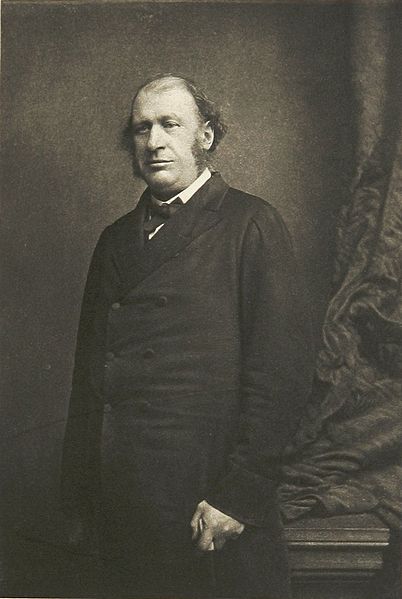
Source: Wikipedia | Alexander Bassano

Source: Wikipedia | Alexander Bassano

The professor is quite right. The Sedition Act 1948 is an archaic piece of legislation. It migrated from 1870 British India to Peninsular Malaya in 1948 (Sabah in 1964 and Sarawak in 1969). While other countries of the Commonwealth, of which Malaysia is a member, have advanced into the modern age, in this country, time stood still. We are still back in the time of Sir James Stephen in 1870 British India. This was pointed out by Sinha CJ in Kader Nath v State of Bihar [1962] AIR, SC 955. In fact section 124A of the Indian Penal Code was the work of Stephen J.

Sir James Stephen was the judge (he was Mr Justice Stephen in England) whose definition of sedition appeared as Article 93 of the Digest of the Criminal Law. I said this before I called on Mr Cumaraswamy to enter on his defence, "Although it may appear to be in English case law that incitement to violence or inciting others to public disorders is an essential ingredient of sedition, it is not so in a criminal code which has as its model Stephen’s definition."

Article 93 of the Digest was used as the model for the crime of sedition in the Criminal Code of the Gold Coast.

So that when we look at section 124A of the Indian Penal Code or at the Criminal Code of the Gold Coast on Sedition, or our own Sedition Act, we are looking at the definition of sedition as apprehended by Sir James Stephen back in the year 1870. The English common law on sedition has developed separately from Stephen’s 1870 definition. As pointed out by Professor Faruqi other nations like the UK, Ireland, India and Australia have moved on to modern times. The modern law of sedition is no longer repressive in other countries but not so in Malaysia where our sedition law is the same law as applied to the colonies of Great Britain back in the year 1870. For us Malaysians we live in a retrograde - this word means moving backwards to a worse state - country where our clock had stopped in the year 1870.

DN BN People's Parliament

Using the ability of the internet for change

Now, I trust you will realize that we Malaysians are in dire straits. Don’t you think it is time for us to move on to a better Malaysia. Like the people of Egypt we can use people’s power to change from tyranny to a true democracy. Use the power of your vote to unseat the oppressors.

We have been under their yoke for 53 years.Enough is enough!

Use facebook and twitter. Use your email and if every reader of this article emails it to his friends we will be able to persuade a whole generation of young people to vote out the BN and replace them with a new government.

It doesn’t matter that the new are inexperienced but at least we have a government of the people, by the people and for the people. It took the English peoples 700 years to get rid of their tyrannical kings. The American people took 250 years to get to where they are today.

I don’t think we will take that long because we are resilient and we have the benefit of hindsight. And above all we have our young people whose young minds will be able to meet the challenges ahead.

Read also:

NH Chan, a much respected former Court of Appeal Judge, is a gavel of justice that has no hesitation in pounding on Federal Court judges with wooden desks for heads. Retired from the Judiciary to become the People’s Judge. Wrote the explosive "Judging The Judges", now in its 2nd edition as "How To Judge The Judges". Once famously hinted at a possible "case match" between lawyer and judge by remarking that "something is rotten in the state of Denmark" (see Ayer Molek Rubber Company Berhad & Ors v Insas Berhad & Anor [1995] 3 CLJ 359). We need more people like NH Chan. That’s why you should buy PASOC and his book.

People’s Call for Regime Change – Part 1

By NH Chan
17 February, 2011

(The People’s Judge reflects on the turmoil in the Middle East – a people’s revolution inspired by the power of the new media on the internet such as Facebook and Twitter – and the lessons for us in Malaysia. He ends with a personal note of his own political awakening, and a call to action for all of us who care for this country.- loyarburok.com)

The uprising in Egypt, the uprising in Tunisia,the uprising in Yemen and even in Jordan there are rumblings in the kingdom. The message is clear. The people do not want their dictators.

And what is the difference between kings, dictators and oligarchs? They are all totalitarian regimes – this means a system of government consisting of only one leader or party and having complete power and control over the people.

But the people do not want that kind of government; they want democracy – this word means a form of government in which the people have a say in who should hold power; they do not want despotism. And this wish of the people could only mean that they want a government of the people, by the people and for the people which is what a true democracy actually is.

In other words, they do not want repressive rule in any shape or form. They want human rights. They do not want draconian and oppressive laws.

In short, they do not want to live under a perennial state of emergency because all emergency laws are only excuses for tyranny. They also want freedom of speech and a free press.

In other words they want a government which is accountable to the people. They want change from authoritarian – this word, which is an adjective, means demanding strict obedience of authority – rule.

And what is the antithesis of totalitarianism? It is democracy, which is what the people really want. In a democracy, the people can choose their own representatives in government. If the people’s choice did not perform up to their expectations they could be replaced by the people.

In a true democracy, there will be no such thing as intervention from an illegitimate source to hijack the people’s choice of representatives in their government.
The foreboding of a dictatorship

What has happened in Egypt and in the Middle East was a people’s call for regime change. The dictators there who have clung to power should have seen the writing on the wall; it was time for them to leave. The people, especially the young people because they are educated and well informed, did not want them. They have overstayed their tenure.

They became corrupted by power; there is a well known adage which says power corrupts and absolute power corrupts absolutely. Any dictatorship is tyrannical – the word means ‘using power in a cruel and oppressive way’ – as was seen in Egypt under Hosni Mubarak who had clung to power for 30 years. In recent events there, we have seen water cannons and tear gas being used on peaceful protestors by the regime. Mubarak’s Gestapo like police have tortured and killed dissenters: I saw a peaceful protestor exclaim on TV “They have shot me! What am I? The enemy?”

In this country we have been governed by the Barisan Nasional (BN) for some 53 years. This country is supposed to be a democracy. But it is not. Guided democracy is nothing more than an excuse for tyranny. We still have draconian laws. People are still being incarcerated under the ISA which is detention without trial. There is police brutality which seems to be endemic in the force. The people’s fundamental freedoms have been muzzled; they have even used the Sedition Act against the country’s citizens.

Respect cannot be forced. If you are good respect comes naturally. The people do not want their legitimately elected state government to be hijacked by the autocrats. What happened in Perak and in Selangor are the clearest examples of governmental wrongdoings. So that if these autocrats are not careful, the tyrannical happenings in this country could easily turn into a catalyst for change.

But we do not want to follow the trend as played out in the Middle East. It is necessary, therefore, that we earnestly take steps to make the change from the BN regime at the next general elections by replacing it with a democratic one.

We do not want autocrats – the word means ‘rulers or persons with absolute power who expect obedience’ – to tell us with supercilious arrogance what is good for us, for that is another excuse for tyranny.

We want our rulers to be answerable to us, the people. Despots are not needed to run this country because they will always be corrupted by power – that is the reason why the Prime Minister and members of his Cabinet should not be allowed to stay in office for more than two terms. The same should apply to the Menteri Besars and the Excos.

Animal Farm

If you have read Animal Farm -a novel by George Orwell, published in 1945 – you will know what I mean. The book is a satire in fable form. The pigs (whose leader is Napoleon) become corrupted by power and a new tyranny replaces the old. The ultimate slogan runs ‘All animals are equal but some animals are more equal than others‘.

The BN has been with us for 53 years and on each succession of the BN government a new tyranny replaces the old. I say this because nothing has changed since the BN came to power. We have the same repressive laws. But there is now a new tyranny. The new evil is the hijacking of a legitimately elected state government in Perak and this, in my estimation, is the last straw for the people of Perak to tolerate. For the rest of the country, remember this, if it can happen in Perak it could happen again elsewhere in this country.

This was mainly the reason that made me change my mind from being apolitical to decide to vote for the underdogs because what the BN had done to Perak was wickedly unfair and unjustifiable.

After reading the book Perak: A State of Crisis I realized that these people do not even know right from wrong. They even gloat in their wrongdoings. We do not want the oligarchy – this word means a country governed by a small group of people – to be more equal than us.

I don’t have to tell you who they are – even in the BN some ‘animals’ are more equal than others. Look at their opulence.

It is a good thing if every member of the Cabinet and every member of the Exco are investigated as to their financial status and assets before they can assume office. And when they leave office they are to be investigated again. They are to be accountable if they are found to be richer than what they could have earned while in office when they leave.

That is why democracy requires the representatives of the people to be accountable to the people. Look at Mr Lim Kit Siang, he has been in politics for as long as I can remember and his son is currently the Chief Minister of Penang. Another was the late Dr Lim Chong Eu. The Perakians and the Penangites know that they are not rich.

One should be in politics to serve the people, not to get rich.

NH Chan, a much respected former Court of Appeal Judge, is a gavel of justice that has no hesitation in pounding on Federal Court judges with wooden desks for heads. Retired from the Judiciary to become the People?s Judge. Wrote the explosive “Judging The Judges”, now in its 2nd edition as “How To Judge The Judges”. Once famously hinted at a possible “case match” between lawyer and judge by remarking that “something is rotten in the state of Denmark” (see Ayer Molek Rubber Company Berhad & Ors v Insas Berhad & Anor [1995] 3 CLJ 359). We need more people like NH Chan. That?s why you should buy PASOC and his book.

Friday, January 14, 2011

A-G Gani Patail should be suspended!

by Din Merican January 13, 201

On Wednesday January 5, 2011, the MACC Corruption Prevention Panel Chairman, Tan Sri Ramon Navaratnam, declared that AG Gani Patail has been cleared of his relationship with former MAS Chairman, Tajuddin Ramli’s proxy, Shahidan Shafie.

The very next day, his colleague Tan Sri Robert Phang, a member of that MACC Panel slammed Ramon for manipulating a closed door confidential meeting to clear A-G Gani Patail. Robert Phang also warned Ramon for making an unauthorized announcement on behalf of the Panel thus rendering the Panel members to be mere rubber stamps to protect and preserve A-G Gani Patail’s position.

However, Ramon insisted that he was entitled to make that statement on behalf of that MACC Panel. If so, was Phang the lone voice in the MACC?

Malaysians were confused. Who is telling the truth, Phang or Ramon? This must have troubled another member of that Panel, Ishak Thamby Kechik, who also issued a statement supporting Phang. It appears that other members of the Panel have been awoken from their slumber and were now speaking out. The full Panel decided to meet to settle this matter once and for all.

On Monday January 10, the full Panel comprising Ramon Navaratnam, Anis Yusal Yusoff, Azman Ujang, Ishak Thamby Kechik, Zainal Abidin Abdul Majid, Prof. Dr. Abdul Rahman Embong and Robert Phang met. Earlier this afternoon (January 12), the MACC Panel made it clear that its chairman Ramon Navaratnam’s statement on January 4 on the matter was his “personal judgment”. This was a damning indictment against Ramon.

Ramon was not telling the truth

Ramon, do the honorable thing and resign

Ramon’s own Panel members are now saying publicly that Ramon was not telling the truth, which means that Ramon is a Liar for announcing that A-G Gani Patail has been cleared by the MACC. This amounted to a vote of no confidence against Ramon. If Ramon has any dignity left in him, he should step down as Chairman of that Panel. If Ramon has any integrity, he would resign from the MACC Panel.

The MACC Panel members must be people with integrity. Ramon has no business being in that Panel if his own Panel members think that he has no integrity. That is as simple as it gets. Let us see if Ramon has dignity and integrity.

The Panel also issued a statement that was reported by MalaysiaKini and which came on Channel 501 Astro Awani news earlier this evening (January 12) that: The Panel also agreed that investigation by the MACC will continue where necessary to ensure the truth or otherwise of any allegations made against the A-G.”

That was exactly the point stressed by Robert Phang, that is, that there has to be a proper investigation before A-G Gani can be cleared. Phang’s criticism against A-G Gani Patail stems from the numerous allegations that had surfaced against the A-G – from manipulation to lying, to outright fabrication and selective prosecution.

Phang resented any attempt to use the MACC Board and Panel to cover-up for A-G Gani Patail. To Phang, the Attorney-General must be free from any form of suspicion of improper conduct. To Phang, A-G Gani Patail’s conduct is far from satisfactory and he would not have the MACC being manipulated to be a fait accompli to A-G Gani Patail’s wrongdoings.

I wrote about all these on 6 January under the title: The Shameful Whitewashing of A-G Gani Patail’s Shenanigans. A-G Gani Patail’s association with Tajuddin’s proxy, Shahidan Shafie, is not just a bare allegation.The fact that A-G Gani and his family went for Haj and shared room with Shahidan was proven by official documents from Tabung Haji:

A-G Gani and Shahidan Haji Together

When invited by MalaysiaKini to publicly clear the air over these serious allegations, both AG Gani Patail and Shahaidan had chosen to remain quiet.

Tajuddin , who was MAS chairman from 1994 to 2001, had been blamed for the national carrier’s massive losses which brought it to the brink of bankruptcy. The Government introduced the Widespread Asset Unbundling (WAU) restructuring of MAS that basically cleaned the slate for MAS to be able to operate again.

Instead of quietly going away, Tajuddin had accused then Prime Minister Tun Dr Mahathir, and then Finance Minster Tun Daim Zainudin, as being responsible for all of his actions in MAS. Tajudin even launched an arbitration claim in Switzerland through a well camouflaged German company called ACL GmbH. Tajudin links with this company had already been exposed as a web of deceit in the chart below:


To close the investigation on MAS, the Director of Commercial Crimes Investigations Department, Dato’ Ramli Yusuff, and Lawyer Rosli Dahlan were charged by A-G Gani Patail on some ridiculous fixed up charges. Both have since been acquitted by the courts without even calling for their defence.

There is already public disquiet over a “Global Settlement” that Tajuddin is attempting to force upon the government. It is so blatantly done under the sanction of the court (see Tajuddin’s Lawyers’s letter below).

Lawyer Rosli Dahlan

Shahidan’s name is specifically mentioned as the new owner of Naluri Bhd which was the corporate vehicle that Tajuddin used to take over MAS. What game is being played here? Why is the government so afraid of Tajudidn that it can be forced to settle all the cases against Tajuddin? If the government can be intimidated, is there any hope of the MAS Scandal ever being fully uncovered? Was that why Dato’ Ramli and Lawyer Rosli were treated so mercilessly?

If A-G Gani Patail is now to face investigation for his connection with Tajuddin and Shahidan in covering up the MAS Scandal, can there be an impartial and independent investigation for so long as A-G Gani Patail remain in office? Is there a possibility of A-G Gani imposing his will on the investigators?

As it is, Dato’ Mat Zain Ibrahim, former CID Chief of KL had accused A-G Gani of fabricating evidence in the “Black Eye Incident” and in planting DNA samples on the mattress in Sodomy I. If, as recent as a few days ago, Tan Sri Ramon Navaratnam of the MACC Panel can be cowed into making a false announcement to clear A-G Gani Patail, what hope can there be for a truthful investigation while A-G Gani remains in power?

What is the norm when a Head of Department faces investigation? In the case of Dato’ Ramli Yusuff, he was stripped of his post, lost all his salary and privileges and until now has yet to be reinstated. The D-G of Tourism, Dato Mirza Thaiyab was suspended. So was the D-G of Immigration, Dato Wahid Don.

Shouldn’t the same happen to A-G Gani Patail? In fact more so, because as the A-G, he is so powerful and has wide powers to decide on criminal proceedings under Article 145 of the Federal Constitution. For sure, he will not approve any prosecution against himself.

Thus, if the government is serious about this; if the Home Minister Dato Seri Hishammuddin wants to show that his bees are not being squeezed by A-G Gani Patail; if they want to show independence in this investigation, the only option is to suspend A-G Gani Patail. Otherwise, this will be just another Cover Up!

Thursday, January 13, 2011

SNAP to be rebranded

Friday, January 7

From the blog - The Broken Shield

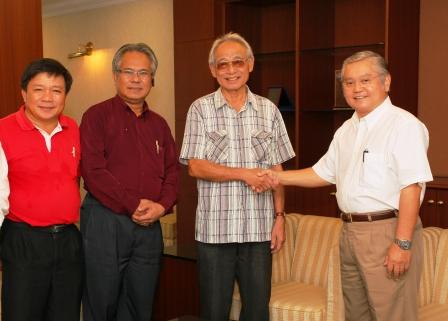
Picture shows the group before the meeting

KUCHING: Discussions have now been carried out between leaders of Sarawak National Party (SNAP) and leaders of the defunct Parti Bansa Dayak Sarawak (PBDS) on the move to rebrand SNAP which has been left in political doldrums for the last eight years after a leadership crisis.

The rebranding of the party will not only make it into a formidable force, but it will become a truly multi-racial party of the future.

Among those involved in the discussions include former PBDS President Daniel Tajem, former PBDS treasurer general Anthony Liman, Douglas Alau, former PBDS executive secretary and several hardcore members of the defunct party, who have not joined any political party since the deregistration of PBDS in 2004.

Committee members of the stillborn Malaysian Dayak Congress (MDC) have also joined the discussions.

Asked to confirm the move, the SNAP Secretary general Stanley Jugol admitted that several discussions have already been held in Kuching and in Miri and a number of these leaders have been appointed to hold key posts in the party.

“SNAP is open to all who share its aspirations and struggle. It is going to remain as an inclusive party working under Pakatan Rakyat (People’s Alliance).

“By rebranding the party, it is hoped that SNAP will once again return to its past glory,” he said, pointing out that the formation of Sarawak Pakatan Rakyat in May last year gave an opportunity for SNAP to play a bigger role both nationally and locally.

“We want to play a bigger role in Pakatan, but the party must first reorganise or rebrand itself in an effort to strengthen the party,” Jugol said, adding that the party needs the expertise and the guidance of the veteran Dayak politicians.

“But we also need young and professional people to come forward to be members of the party, because they are going to be the future leaders of the party,” he said.

Jugol said that the party has agreed to organise asymposium in Sibu on 15 January to explain the move to the people.

He also said that another symposium will be held in Kuching towards the end of the month on the same objective.

Later in February, the “new” SNAP will be launched, he said.

Jugol said that the party also agreed to form a “Council of Elders” whose main task is to guide and advice the party on matters of importance such as the issues of native customary rights land, traditions, customs and Adat.

Following a bitter leadership crisis in 2002, SNAP was not only reduced into a “mosquito” party, but was also deregistered by the Registrar of Societies. However, it was given a stay of execution pending its appeal to High Court. It was only on 26 June last year that the Court decided on SNAP’s favour.

The crisis began when the party found its former Treasurer General Tiong King Sing, the MP for Bintulu guilty as charged for tarnishing the name of the party over the failed TV3 building project in Bintulu.

His expulsion on 11 April 2002 led to nine central executive committee members walking out from the meeting as they did not agree with the decision of the party.

It also triggered the mass resignations of nine of its elected representatives and members who on 5 November 2002 formed Sarawak Progressive Democratic Party (SPDP). The “gang of nine” as they were popularly known was led by William Mawan Ikom, who later became president of the newly formed party.

The third party to be formed after Sarawak United People’s Party (SUPP) and Party Negara Sarawak (PANAS), SNAP’s formation on 10 April 1961 opened the way for the Dayaks to participate in politics during Sarawak’s preparation for independence.

When Sarawak became independence through the formation of Malaysia in September 1963, Ningkan who was the founding secretary general was made Sarawak’s first chief minister.

In the height of its electoral successes, SNAP had nine MPs and 18 state legislators. In 1976 SNAP joined the Barisan Nasional until it was unceremoniously kicked out in 2002.

Today it joins a new coalition, Pakatan Rakyat together with DAP, PKR and PAS.

Friday, August 20, 2010

Scandal of Sarawak’s Budget Black Hole

Scandal of Sarawak’s Budget Black Hole

Thursday, August 19th, 2010 GMT

DAP - Winners at Sibu, have tough questions for Taib

Scandal highlighted by DAP

Taib Mahmud, the Chief Minister of Sarawak, has failed to account for a staggering RM 4.8 billion of government expenditure over the past 3 years alone, according to explosive figures released by the opposition DAP party. This represents more than half the Development Budget, which in turn represents nearly three quarters of the total expenditure for the State!

Put another way, in 2009 RM 1.825 billion of the State’s total expenditure was allocated to persons unknown, compared to the government’s estimated revenue for that year of RM 3.726 billion. That is about half of all your cash!

The secret projects soaking up Sarawak’s cash

The DAP, who recently triumphed over BN at the Sibu by-election, have produced a closely argued Alternative Budget for 2010, in which they demand a return to proper accounting methods, so that taxpayers can know exactly how their money has been spent. This is their right and it is also Malaysian law, in line with the rest of the civilised world.

The DAP figures show that Taib has not only reserved 80% of the State’s entire Development Budget to the three Ministries controlled directly by himself, but that shockingly most of that money has been spent on secret projects about which he has provided zero information.

Under the circumstances the people of Sarawak are entitled to assume that the money has been stolen. As the DAP points out:

“This [state of affairs] defies the basic principle of political accountability in a democratic system and is susceptible to great abuses”.

So let us all guess what those abuses might be and where the money might have gone. Some on more Rolls Royces for the Chief Minister? Some on more foreign properties for his family? Some on bailing out projects by Taib-owned companies?

The Chief Minister appears to think he can get away with not telling people where he has decided to spend this money, but we can be comfortably certain that none of these secret projects involve benefitting any of the impoverished people whose lands he has taken for palm plantations now owned by his family and friends.

The “Government Contribution Towards Approved Agencies Trust Fund”

So what is going on and how has all this money disappeared?

The DAP budget documents provides a detailed analysis. Firstly, it outlines the extraordinary level of personal control that Taib has assumed over Sarawak’s expenditure. The septuagenarian personally manages the three main spending departments in the State. This means that almost every spending decision has to go through him and that no other Minister can do anything without getting his permission.

In particular his three ministries (the Finance Ministry, Planning and Resources Ministry and Chief Ministry) together control 80% of the Development Budget, which alone accounts for around three quarters of all money spent, although it is argued many of the projects would more sensibly belong under different departments.

Secondly, the document explains the secretive system that the Chief Minister has developed for allocating more half this huge sum of money. Over the past several years he has employed a highly mysterious expenditure category termed the ‘Government Contribution towards Approved Agencies Trust Fund’ into which this money is channelled. There is no specification as to who these ‘Approved Agencies’ are or which Trust Fund is being referred to and the Government has consistently refused requests for information on the subject! It could be going to his aunty, or his sister, or cousins, or kids, or secret mistress…… how is anyone supposed to know and what right has he to keep it secret?

Thus, in 2009 RM 1.825 billion (59.3% of the total RM 2.430 billion) is unaccounted for in the Development Budget, according to the DAP calculations. In 2008 it was RM1.719 billion (60% of the total RM2.865 billion) and in 2007 it was RM1.257 billionn (54.8% of the total RM2.294 billion). The DAP raise the valid question as to what is the point of carefully auditing 40% of the budget if the remaining 60% is kept secret?

The truth must be told

We can only assume that the ‘Approved Agencies’ must be outfits the Chief Minister would rather we did not know about. Certainly, if these ‘Approved Agencies’ were doing any good to the people he is supposed to serve, then he would be broadcasting the fact next to a picture of himself in every page of the Borneo Post!

However, he is not and therefore we can safely conclude that they are just doing good for the Taib family and their business cronies, like so many of his other projects.

Tuesday, August 10, 2010

Unmasked! Taib The Godfather

Unmasked! Taib The Godfather

Monday, August 9th, 2010 GMT

Held in trust by private agreement - 50% of the shares of Sakti International, worth approximately US$ 40 million.

Sarawak Report has uncovered devastating documents which prove that Abdul Taib Mahmud, Sarawak’s Chief Minister, is the real owner of millions of dollars of property assets held in the name of family members abroad.

The damning discovery lays bare a system of private deals, which enabled the Chief Minister to conceal his true ownership of the properties. This was presumably in order to hide the extent of his enormous wealth, for which he has yet to provide any legitimate explanation.

Under the system, whilst it is Taib’s relatives who are publicly registered as the official shareholders and directors of the companies owning the properties, a separate, private agreement ensures that the shares are actually held in trust for him.
Download PDF.

Documentary evidence of elaborate concealment

260 California Street, San Francisco - Bijou Sakti Office Block

Among documents in its possession Sarawak Report has a copy of one such private agreement (see above) relating to the shares in Sakti International, a company that owns buildings in San Francisco. Sakti is part of a web of companies started in North America by the Taibs, which includes Sakto, a major Ottawa property company, and Wallysons, which owns the Abraham Lincoln Building in Seattle, housing a top secret anti-terrorist facility for the FBI.

The five official shareholders of Sakti International, which is registered in California, are Taib’s brothers, Onn Mahmud and Arip Mahmud, along with three of his children, Sulaiman Taib, Mahmud Taib and Jamilah Taib. However, as the document which we have obtained shows, a resolution made soon after the formation of the company has privately ruled that half those shares (a commanding majority) are held in trust for the Chief Minister. The value of these shares amounts to 40 million US dollars for Sakti alone, according to the company’s own documents.

Tip of the iceberg?

However, Sakti International, estimated to be worth US $80 million, accounts for just a small proportion of the Taib family wealth. Our previous exposes have revealed a vast portfolio of further international property assets, which are owned by members of Taib Mahmud’s immediate family. For example, Taib’s own children are the shareholders and directors of numerous companies controlling residential and commercial buildings in Canada, Australia, Britain and the United States together worth hundreds of millions of US dollars. Yet, suspiciously, many of these assets came into their possession when they were in their early 20s and still college students with no visible access to legitimate resources to invest. The inevitable question for Taib Mahmud, therefore, is whether, as in the case of Sakti International, they are also secretly holding these other properties in trust for him? If not, what explanation can there be for these investments?

Golden Wedding Couple - The Godfather and his family

A number of reports have already been made to the Malaysian Anti Corruption Commission (MACC) regarding the recent disclosures of the Taib family wealth. These new revelations proving the direct link to the Chief Minister will increase the pressure on the MACC to respond with a proper investigation.

Further Fingerprints

The Sakti International documents in our possession, released as part of the disclosure in a recent court case, provide further extensive evidence of Taib Mahmud’s involvement in the company, despite his denials of any business connections. Indeed one of the company’s earliest official documents, signed in 1987, even lists him as one of the Directors of Sakti International.

Chief Minister's name in black and white, listed as a Director Of Sakti International

The document in question is a Domestic Stock Corporation Statement for Sakti International, which is required annually by the State of California. In 1987, the year the company was set up, its inaugural statement clearly registers Taib Mahmud, along with his brothers Onn Mahmud and Arip Mahmud, as a Director of the company. The only officer of the company is listed as Mahmud Taib, the Chief Minister’s eldest son.

It is well-known that in subsequent Taib family enterprises the Chief Minister has always scrupulously avoided including his own name in any documentation. This early mistake will undermine his constant claims that, in keeping with his role as Chief Minister, he has no direct business interests. It is clear that he in fact set up Sakti International, using the address of his own house in San Francisco. Download PDF

Cover Up

Subsequently, records show that the structure of the company was altered to make Onn, Arip and Mahmud Taib the three Directors, while Rahman became the only officer of the company. But, as we are now able to exclusively report, Taib Mahmud secretly retained his control through a resolution by the company directors dated April 8th 1988. This resolution (see top) placed 500 of the 1,000 shares issued by the company in trust for him.

43 Presidio, Taib's San Francisco town house and early HQ for Sakti International

The Godfather

The Sakti documents give a fascinating insight into the manipulative methods used by Taib Mahmud to control his family members, who are supposedly the earners and ‘businessmen’ who have generated the Taibs’ legendary wealth. The five relatives who were selected to own shares in Sakti International were each been given a different number of shares. Each then surrendered differing proportions of these shares to be held in trust for the Chief Minister.

Brother Onn Mahmud gets 400 shares, but of them 200 are held for the Chief Minister, whereas brother Arip gets just 200 shares, 100 of which are in trust for Taib. Mahmud Taib has the same arrangement ast Arip. However younger brother, Sulaiman Rahman Taib, who was later made sole Director of Sakti, only gets 100 shares under the agreement and they are all in fact held in trust for his father. Daughter Jamilah also only gets 100 shares, but she gets to hold them all herself.

The system ensures that Taib Mahmud has half of all the shares held in trust for himself, whereas none of the others hold more than 200 shares. In this way he clearly keeps a commanding control over the company he pretends not to own.

Classic Car on Standby - Vintage Ferrari kept ready for Chief Minister's occasional visits to 43 Presidio Avenue. Son Rahman Taib, who shared his father's interest requested a 4,000 square foot garage to house his car collection in the States

Taib in charge

Former employees of Sakti have testified to the controling position the Chief Minister holds over the other members of the family. Rahman, as he was known in the States, was still in college when he became sole Director of Sakti and has been described as being in awe of his father, whom he once had to wait a week to get a meeting with.

“We always considered Taib to be the ultimate boss and decision-maker” one former executive has told Sarawak Report, “It was obvious that he was the source of the money and Rahman was extremely deferential towards him”.

Where did the money come from?

The Chief Minister has so far made no comment on the string of recent exposes regarding his wealth. However, this new evidence will increase the widespread demands for him to explain how he and his family accrued the millions necessary to acquire such investments. Taib’s personal salary from his numerous concurrent positions still only delivers an official income of just under 50,000 MYR (around US $16,000) a month.

Multi-billionaire? Chief Minister's finances beg immediate scrutiny

In past weeks the existence of Ridgeford Properties in London and Sakto Corporation in Ontario, Canada have also been made public (see previous exposes on Sarawak Report). These companies own and manage numerous office blocks worth hundreds of millions of dollars. Ostensibly the Directors and owners of these concerns are Jamilah Taib and her husband Sean (Hisham) Murray, a Canadian national. However, like Sakti, Sakto was originally set up under the names of Taib family members, not Mr Murray.

Although numerous members of Sean Murray’s family now work for Sakto, all the evidence indicates that these are in fact Taib family businesses, ultimately controlled by the Chief Minister of Sarawak.

Surely the weight of evidence is now such that the Malaysian Anti-Corruption Commission will be unable to ignore the deluge of demands requiring thorough investigation into Sarawak’s White Haired Raja? - Sarawak Report

Saturday, July 31, 2010

Now let’s have a discussion — Tengku Razaleigh Hamzah

July 31, 2010

JULY 31 — Thank you for inviting me to speak with you. I am truly honoured. I have played some small role in the life of this nation, but having been on the wrong side of one or two political fights with the powers that be, I am not as close to the young people of this country as I would hope to be. History, and the 8 o’clock news, are written by the victors. In recent years the government’s monopoly of the media has been destroyed by the technology revolution.

You could say I was also a member of the UKEC. Well I was, except that belonged to the predecessor of the UKEC by more than fifty years, The Malayan Students Union of the UK and Eire. I led this organisation in 1958/59. I was then a student of Queen’s University at Belfast, in a rather cooler climate than Kota Bharu’s.

Your invitation to participate in the MSLS was prefaced by an essay which calls for an intellectually informed activism. I congratulate you on this. The Youth of today, you note, “will chart the future of Malaysia.” You say you “no longer want to be ignored and leave the future of our Malaysia at the hands of the current generation.” You “want to grab the bull by the horns... and have a say in where we go as a society and as a nation.”I feel the same, actually. A lot of Malaysians feel the same. They are tired of being ignored and talked down to by swaggering mediocrities.

You are right. The present generation in power has let Malaysia down.

But also you cite two things as testimony of the importance of youth and of student activism to this country, the election results of 2008 and “the Prime Minister’s acknowledgement of the role of youth in the development of the country.”

So perhaps you are a little way yet from thinking for yourselves. The first step in “grabbing the bull by the horns” is not to required the endorsement of the Prime Minister, or any Minister, for your activism.

Politicians are not your parents. They are your servants. You don’t need a government slogan coined by a foreign PR agency to wrap your project in. You just go ahead and do it.

When I was a student our newly formed country was already a leader in the postcolonial world. We were sought out as a leader in the Afro-Asian Conference which inaugurated the Non-Aligned Movement and the G-77. The Afro-Asian movement was led by such luminaries as Zhou En-lai, Nehru, Kwame Nkrumah, Soekarno. Malaysians were seen as moderate leaders capable of mediating between these more radical leaders and the West. We were known for our moderation, good sense and reliability.

We were a leader in the Islamic world as ourselves and as we were, without our leaders having to put up false displays of piety. His memory has been scrubbed out quite systematically from our national consciousness, so you might not know this or much else about him, but it was Tengku Abdul Rahman established our leadership in the Islamic world by coming up with the idea of the OIC and making it happen.

Under his leadership Malaysia led the way in taking up the anti-apartheid cause in the Commonwealth and in the United Nations, resulting in South Africa’s expulsion from these bodies.

Here was a man at ease with himself, made it a policy goal that Malaysia be “a happy country”. He loved sport and encouraged sporting achievement among Malaysians. He was owner of many a fine race horse.

He called a press conference and had a beer with his stewards when his horse won at the Melbourne Cup. He had nothing to hide because his great integrity in service was clear to all. Now we have religious and moral hypocrites who cheat, lie and steal in office but never have a drink, who propagate an ideologically shackled education system for all Malaysians while they send their own kids to elite academies in the West.

Speaking of football. You’re too young to have experienced the Merdeka Cup, which Tunku started. We had a respectable side in the sixties and seventies. Teams from across Asia would come to play in Kuala Lumpur. Teams such as South Korea and Japan, whom we defeated routinely. We were one of the better sides in Asia. We won the Bronze medal at the Asian games in 1974 and qualified for the Moscow Olympics in 1980. Today our FIFA ranking is 157 out of 203 countries. That puts us in the lowest quartile, below Maldives (149), the smallest country in Asia, with just 400,000 people living about 1.5 metres above sea level who have to worry that their country may soon be swallowed up by climate change. Here in ASEAN we are behind Indonesia, Thailand, Singapore, whom we used to dominate, and our one spot above basketball-playing Philippines.

The captain of our illustrious 1970’s side was Soh Chin Aun. Arumugam, Isa Bakar, Santokh Singh, James Wong and Mokhtar Dahari were heroes whose names rolled off the tongues of our schoolchildren as they copied them on the school field. It wasn’t about being the best in the world, but about being passionate and united and devoted to the game.

It was the same in Badminton, except at one time we were the best in the world. I remember Wong Peng Soon, the first Asian to win the All-England Championship, and then just dominated it throughout the 1950. Back home every kid who played badminton in every little kampong wanted to call himself Wong Peng Soon. There was no tinge of anybody identifying themselves exclusively as Chinese, Malays, Indian. Peng Soon was a Malaysian hero. Just like each of our football heroes. Now we do not have an iota of that feeling. Where has it all gone?

I don’t think it’s mere nostalgia that that makes us think there was a time when the sun shone more brightly upon Malaysia. I bring up sport because it has been a mirror of our more general performance as nation. When we were at ease with who we were and didn’t need slogans to do our best together, we did well. When race and money entered our game, we declined. The same applies to our political and economic life

Soon after independence we were already a highly successful developing country. We had begun the infrastructure building and diversification of our economy that would be the foundation for further growth. We carried out an import-substitution programme that stimulated local productive capacity. From there we started an infrastructure buildup which enabled a diversification of the economy leading to rapid industrialisation. We carried out effective programmes to raise rural income and help with landless with programmes such as FELDA. Our achievements in achieving growth with equity were recognised around the world. We were ahead of Our peer group in economic development were South Korea, Hong Kong, Singapore and Taiwan, and we led the pack. I remember we used to send technical consultants to advise the South Koreans.

By the lates nineties, however, we had fallen far behind this group and were competing with Thailand and Indonesia. Today, according to the latest World Investment Report, FDI into Malaysia is at about a twenty year low. We are entering the peer group of Cambodia, Myanmar and the Philippines as an investment destination. Thailand, despite a month long siege of the capital, attracted more FDI than we did last year. Indonesia and Vietnam far outperform us, not as a statistical blip but consistently. Soon we shall have difficulty keeping up with The Philippines. This, I believe, is called relegation. If we take into account FDI outflow, the picture is even more interesting. Last year we received US$1.38 billion (RM4.40 billion) in investments but US$ 8.04 billion flowed out. We are the only country in Southeast Asia which has suffered nett FDI outflow. I am not against outward investment. It can be a good thing for the country. But an imbalance on this scale indicates capital flight, not mere investment overseas.

Without a doubt, Malaysia is slipping. Billions have been looted from this country, and billions more are being siphoned out as our entire political structure crumbles. Yet we are gathered here in comfort, in a country that still seems to ‘work.’ Most of the time. This is due less to good management than to the extraordinary wealth of this country. You were born into a country of immense resources both natural and cultural and social. We have been wearing down this advantage with mismanagement and corruption. With lies, tall tales and theft. We have a political class unwilling or unable to address the central issue of the day because they have grown fat and comfortable with a system built on lies and theft. It is easy to fall into the lull caused by the combination of whatever wealth has not been plundered and removed and political class that lives in a bubble of sycophancy.

I urge you not to fall into that complacency. It is time to wake up. That waking up can begin here, right here, at this conference. Not tomorrow or the day after but today. So let me, as I have the honour of opening this conference, suggest the following:

  • Overcome the urge to have our hopes for the future endorsed by the Prime Minister. He will have retired, and I’ll be long gone when your future arrives. The shape of your future is being determined now.
  • Resist the temptation to say “in line with” when we do something. Your projects, believe it or not, don’t have to be in line with any government campaign for them to be meaningful. You don’t need to polish anyone’s apple. Just get on with what you plan to do.
  • Do not put a lid on certain issues as “sensitive” because someone said they are. Or it is against the Social Contract. Or it is “politicisation”. You don’t need to have your conversation delimited by the hyper-sensitive among us. Sensitivity is often a club people use to hit each other with. Reasoned discussion of contentious issues builds understanding and trust. Test this idea.
  • It’s not “uber-liberal” to ask for an end to having politics, economic policy, education policy and everything and the kitchen sink determined by race. It’s called growing up. Go look up “liberal” in a dictionary.
  • Please resist the temptation to say Salam 1 malaysia, or Salam Vision 2020 or Salam Malaysia Boleh, or anything like that. Not even when you are reading the news. It’s embarrassing. I think it’s OK to say plain old salam the way the Holy Prophet did, wishing peace unto all humanity. You say you want to “promote intellectual discourse.” I take that to mean you want to have reasonable, thought-through and critical discussions, and slogans are the enemy of thought. Banish them.
  • Don’t let the politicians you have invited here talk down to you.
  • Don’t let them tell you how bright and “exuberant” you are, that you are the future of the nation, etc. If you close your eyes and flow with their flattery you have safely joined the caravan, a caravan taking the nation down a sink hole. If they tell you the future is in your hands kindly request that they hand that future over first. Ask them how come the youngest member of our cabinet is 45 and is full of discredited hacks? Our Merdeka cabinet had an average age below thirty. You’re not the first generation to be bright. Mine wasn’t too stupid. But you could be the first generation of students and young graduates in fifty years to push this nation through a major transformation. And it is a transformation we need desperately.
  • You will be told that much is expected of you, much has been given to you, and so forth. This is all true. Actually much has also been stolen from you. Over the last twenty five years, much of the immense wealth generated by our productive people and our vast resources has been looted. This was supposed to have been your patrimony. The uncomplicated sense of belonging fully, wholeheartedly, unreservedly, to this country, in all it diversity, that has been taken from you.

Our sense of ourselves as Malaysians, a free and united people, has been replaced by a tale of racial strife and resentment that continues to haunt us. The thing is, this tale is false.

The most precious thing you have been deprived of has been your history. Someone of my generation finds it hard to describe what must seem like a completely different country to you now. Malaysia was not born in strife but in unity. Our independence was achieved through a demonstration of unity by the people in supporting a multiracial government led by Tengku Abdul Rahman. That show of unity, demonstrated first through the municipal elections of 1952 and then through the Alliance’s landslide victory in the elections of 1955, showed that the people of Malaya were united in wanting their freedom.

We surprised the British, who thought we could not do this.

Today we are no longer as united as we were then. We are also less free. I don’t think this is a coincidence. It takes free people to have the psychological strength to overcome the confines of a racialised worldview. It takes free people to overcome those politicians bent on hanging on to power gained by racialising every feature of our life including our football teams.

Hence while you are at this conference, let me argue, that as an absolute minimum, we should call for the repeal of unjust and much abused Acts which are reversals of freedoms that we won at Merdeka.

I ask you in joining me in calling for the repeal of the ISA and the OSA. These draconian laws have been used, more often than not, as political tools rather than instruments of national security. They create a climate of fear. These days there is a trend among right wing nationalist groups to identify the ISA with the defence of Malay rights. This is a self-inflicted insult on Malay rights. As if our Constitutional protections needed draconian laws to enforce them. I wish they were as zealous in defending our right not to be robbed by a corrupt ruling elite. We don’t seem to be applying the law of the land there, let alone the ISA.

I ask you to join me in calling for the repeal of the Printing and Publications Act, and above all, the Universities and Colleges Act. I don’t see how you can pursue your student activism with such freedom and support in the UK and Eire while forgetting that your brethren at home are deprived of their basic rights of association and expression by the UCA. The UCA has done immense harm in dumbing down our universities.

We must have freedom as guaranteed under our Constitution. Freedom to assemble, associate, speak, write, move. This is basic. Even on matters of race and even on religious matters we should be able to speak freely, and we shall educate each other.

It is time to realise the dream of Dato’ Onn and the spirit of the Alliance, of Tunku Abdul Rahman. That dream was one of unity and a single Malaysian people. They went as far as they could with it in their time. Instead of taking on the torch we have reversed course. The next step for us as a country is to move beyond the infancy of race-based parties to a non-racial party system. Our race-based party system is the key political reason why we are a sick country, declining before our own eyes, with money fleeing and people telling their children not to come home after their studies.

So let us try to take 1 Malaysia seriously. Millions have been spent putting up billboards and adding the term to every conceivable thing. We even have cuti-cuti 1 Malaysia. Can’t take a normal holiday anymore.

This is all fine. Now let us see if it means anything. Let us see the Government of the day lead by example. 1 Malaysia is empty because it is propagated by a Government that promotes the racially-based party system that is the chief cause of our inability to grow up in our race relations. Our inability to grow up in our race relations is the chief reason why investors, and we ourselves, no longer have confidence in our economy. The reasons why we are behind Maldives in football, and behind the Philippines in FDI, are linked.

So let us take 1 Malaysia seriously, and convert Barisan Nasional into a party open to all citizens. Let it be a multiracial party open to direct membership. PR will be forced to do the same or be left behind the times. Then we shall have the vehicles for a two party, non-race-based system.

If Umno, MIC or MCA are afraid of losing supporters, let them get their members to join this new multiracial party. PR should do the same. Nobody need feel left out. Umno members can join en masse. The Hainanese Kopitiam Association can join whichever party they want, or both parties en masse if they like. We can maintain our cherished civil associations, however we choose to associate. But we drop all communalism when we compete for the ballot. When our candidates stand for Elections, let them ever after stand only as Malaysians, better or worse.

Now let’s have a discussion.

* Tengku Razaleigh Hamzah’s speech at the UKEC’s Fourth Malaysian Students Leadership Seminar in Kuala Lumpur on July 31, 2010.