Sunday, November 30, 2008

PKR expects more election victories


By Adib Zalkapli
Sunday November 30 2008

SHAH ALAM, Nov 29 – Parti Keadilan Rakyat declared that the opposition coalition Pakatan Rakyat expects to win more seats in Parliament.

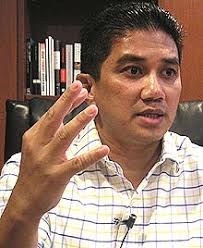
PKR vice president Azmin Ali said the party is now preparing to face by-elections in Pensiangan and Kuala Terengganu.

An election court in September quashed Tan Sri Joseph Kurup's victory, who won uncontested in the March 8 general election and a by-election is expected pending an appeal by Barisan Nasional.

Yesterday, two term Kuala Terengganu MP Datuk Razali Ismail passed away while playing badminton.

"I believe Kuala Terengganu will become Pakatan Rakyat's seat," said Azmin at a public rally here today.

"The seat belongs to Pas. We accept the decision made by the Pakatan leadership and will fight to ensure our victory," he added.

In the last general election Pas candidate Mohamad Sabu was defeated by 628 votes. An independent candidate, Maimun Yusuf lost her deposit.

The PKR election director also told thousands of party supporters at Malawati Stadium that the party has activated its machinery to face the Sarawak state election.

He said that people's mood in the state has changed compared to during the last state election in 2006.

"We were chased out by the people then, as we are a Peninsular political party, but now they have become receptive to our struggle," he said while praising Ngemah state assemblyman Gabriel Adit who joined the party two weeks ago.

Prior to Adit's admission into the party, Dominic Ng of Padungan was PKR's sole representative in the Sarawak assembly.

Azmin also reiterated the party's stand that it would continue its struggle to topple the BN government and declared that the opposition coalition would take over Putrajaya soon.

"After March 8, the people keep asking for a change, we heard them during the Permatang Pauh by-election. We won with a bigger majority. The Malays who were threatened chose to be with us," said Azmin.

Saturday, November 29, 2008

Azizah slams power transition plan


Rahmah Ghazali | Nov 29, 08 1:01pm

PKR president Dr Wan Azizah Wan Ismail today slammed the March transition plan of Prime Minister Abdullah Ahmad Badawi and his deputy, Najib Tun Razak, saying it would not bring any positive changes to the country.

During a policy speech at the PKR annual congress in Stadium Malawati, Shah Alam this morning, she told the 4000-strong crowd that the transition plan would only impact the nation in a negative way.

"We are here to stress that the transition plan between the prime minister and his deputy, Najib Abdul Razak will not make any positive changes to the damage that has been done to the judicial system, the police, the Anti-Corruption Agency and Parliament," she said.

Wan Azizah, who is also former Permatang Pauh MP and the wife of PKR de-facto leader Anwar Ibrahim, said the transition plan would be "no different than the old regime", referring to the tenure of Dr Mahathir Mohamad.

"It will have so much similarities with the old regime, where the Internal Security Act and corruption were widely practised. The same regime also contributed to the terrible erosion of government institutions," she added.

The transition plan, which was originally planned for June 2010, had to be pushed forward to next March after Abdullah was forced to review his departure date after losing support from Umno grassroots in the wake of the huge loses suffered by Barisan Nasional in the last general election.

Najib, who is Umno deputy chief, last month won the leadership of the ruling party unopposed, paving the way for him to be appointed prime minister next March.

Touching on the good relationship between the political parties in Pakatan Rakyat, Wan Azizah also reiterated PKR’s commitment to DAP and PAS, saying the opposition coalition would do all in its power to preserve the special position of the Malay rulers, Malays, Islam and Bahasa Melayu.

"In fact, we are willing to return royal immunity in the spirit of a constitutional monarchy. This is the real meaning of the change we are committed to bringing to the country," she said.

However, she clarified in a press conference later that she was not talking about the restoration of royal immunity per se but restoring the power of the Agong in the law-making process.

According to Wan Azizah, she was referring to restoring the Agong's power to reject a Bill in enacting a new law. At present, any bill that is not assented by the Agong will be passed in 30 days.

Growing support from Sabah and Sarawak

Wan Azizah today also vowed to pull off an "incredible performance" during Sarawak’s state election next year. She said PKR had thousands of new members, mostly from Sabah and Sarawak, a strong indication of winds of change sweeping the two states.

"If we were able to gain power in Sabah and Sarawak during the previous general election, we could have formed a new federal government by now. Insya’Allah this hope will materialise when the time comes," said the 56-year-old politician.

She added that PKR was currently in the midst of strengthening the party’s relationship with the two states to "ensure a more successful future" with them.

"We are also committed to our promise - where 20 percent of petroleum and oil revenues in Sabah and Sarawak will be given back to the people.

"We also promise to give more pro-active roles to these states at the federal level if we are chosen to lead the country one day," stressed Wan Azizah - malaysiakini.com

Wednesday, November 26, 2008

Out of Touch Politicians


by Khoo Kay Peng
Straight Talk - Only for the Straight Talkers.

At lunch today, I spoke to a good friend and a journalist about Malaysian politicians. He opined they are a complacent lot. I would like to add that many of these politicians are incompetent too.

We elected politicians to help us govern the country. Politicians should work hand-in-hand with the public, NGOs and businesses to drive and coordinate policies. These policies are needed to regulate social life, public safety, economy, education and others. We do not need politicians to play moral cops.

At a time when the economy is facing a risk of downturn amidst the looming global economic crisis, we do not need politicians who are fixated with a ban on yoga, alcohol and other menial and insignificant issues.

The manufacturing sector is facing a slowdown. Many factories in the country are already cutting down production, freezing headcount and implement cost cutting measures. We need to create new jobs to cater for the workers retrenched especially those working in the financial industry in Singapore and abroad.

Starting from the first quarter of 2009, consumer demand is expected to face a downturn as more households will hold back spending after the Chinese New Year festive.

Car sales, a general barometer used to measure consumption, has fallen by 26% in October. Overall, the car industry can expect a double digit contraction in 2009.

Yet, the government is still struggling to come out with the right stimulus to help sustain and support job creation and consumer demand.

Prime Minister Abdullah Badawi is more prompt in his response to a ban on yoga than the economic crisis.

Individual income tax rates are still high. The government should reduce income tax rates by 3% for all Malaysians. More money should be put in the hands of Malaysians and allow them to make their own consumption decision. The government does not have a good track record in using public funds.

Government's decision to pump prime the economy through infrastructure development is a good move. But this sector does not hire that many local workers. The government should also consider spending on infrastructure and building maintenance and refurbishment. Several parts of Kuala Lumpur, Georgetown and other major cities are worn out. Urban renewal is necessary. It will create more jobs for local expertise.

Deputy Prime Minister Najib Razak should not talk about winning two-thirds majority before even taking over the hot seat. He should plan how to heal the economy, social rifts and racial bigotry in the country. Not to mention his own huge political baggage.

For goodness sake, we need sensible and smart politicians. Not those who are out-of-touch, complacent and simply incompetent.

About the Author
Khoo Kay Peng is an economics graduate from the University of Malaya. He pursued his postgraduate master's in International Relations at the University of Warwick, UK. He is a British Chevening scholar. Kay Peng is a corporate consultant and an independent political analyst. He is often invited to speak at various forums, corporate events and workshops. He co-authors the book on "Non-Sectarian Politics in Malaysia: The Case of Parti Gerakan Rakyat Malaysia". His views, articles and comments are carried by many local and foreign news agencies, newspapers, magazines, TV & radio stations. A 'Anak Malaysia', he advocates a non-racial society and a good governance. Contact Kay Peng at kpkhoo @ yahoo.com

Tuesday, November 25, 2008

Sultans flex their power

Malaysian Insider
By Leslie Lau, Consultant Editor
Tuesday, 25 November 2008 11:56

NOV 25 — As disputes between the various communities in Malaysia grow, and amid the constant tug-of-war between conservatives, moderates and liberals over social and religious values, the stature and position of Malaysia's royal households have shifted upwards.

Yesterday, the Sultan of Selangor Sultan Sharafuddin Idris Shah made it clear that his authority as head of Islam in the state would not be usurped by the National Fatwa Council.

Referring to the council's fatwa declaring yoga haram, the Sultan said he hoped future edicts which affected the general public would be referred to the Rulers Conference prior to being announced.

He also said the state fatwa committee would meet on the yoga issue and make recommendations to him.

In Perak, a state government official also retracted yesterday an earlier statement that the state would adopt the fatwa, saying royal consent was first needed.

The move taken by the two Sultans is seen by some quarters as taking a stand against the kind of creeping conservatism that could affect race relations in the country.

But it is also a reflection of a lack of political leadership.

Since the March 8 general election when the Barisan Nasional lost its two-thirds majority in Parliament, the Sultans have begun playing a more significant role.

In states like Perak, Selangor and Terengganu, the Sultans played a key role in determining the leadership of the state governments.

The Raja Muda of Perak, Raja Nazrin Shah, has grown in stature, especially among the more moderate and liberal groups in the country.

Last week, he made the kind of speech which is usually expected from political leaders in an attempt to calm the roiling debates over race relations.

He called on Malaysians to embrace multiculturalism and pointed out that society must reject radicalism and extremism.

Members of the royalty appear to have come forward to fill a vacuum created since March 8 in which Umno, MCA, MIC, Gerakan and other BN parties have found it rough going dealing with a much more significant opposition in Pakatan Rakyat.

The power struggles within Umno and MCA have also released a wave of strident, aggressive and more racial approaches as the two major parties try to retreat to their core support and race ideologies.

While there may still be some apprehension over a more active royalty, and their actual constitutional role, it is clear now that public support for them is growing.

The credibility of political leaders in the country has taken a severe battering recently, and their standing among the public remains low.

Ultimately they have their work cut out for them if they are to reclaim the leadership role from some of Malaysia's more socially-conscious Sultans.

Saturday, November 22, 2008

JOHAN JAAFFAR: To be strong, Umno needs to be clean


Saturday, November 22, 2008

By : JOHAN JAAFFAR

THE secretary-general of Umno told the world "my party is sick". Perhaps he was asked to comment on the incidents of fighting and chair-throwing at the recent divisional meetings, but these are merely symptoms of the current problems bedevilling the party. The truth is, all is not well with Umno today.

Its detractors would argue that Umno has lost touch with reality and is fast becoming irrelevant. It is wrapped in a time capsule while the world moves on. Umno, the once venerable institution, is living on past glory. Umno is the party of yesteryear that refuses to reinvent itself. It does not speak the language of today's youth. It fails to understand the emergence of generations X and Y among the Malays. It has become largely a party of pakcik and makcik (uncles and aunties).

Not so, say its defenders. Umno will remain relevant forever. It is a party that has changed with time, in fact realigning itself to face the challenges of the day. It is not the myopic party that some would like to believe; it is in fact a dynamic one ferociously grounded in reality. More importantly, as long as the Malays are around, Umno will be their hope and legitimate representative.

The Malays are changing, more so their values and world views. These are not the same ones who had supported Umno in 1946. Those who fought the Malayan Union, the nationalists who were instrumental in demanding independence and the post-Merdeka generation of leaders are long gone.

Umno's policies have created a new generation of Malays -- educated, successful and more assertive. The rise of Malay businessmen and women is one of the proud legacies of Umno leaders' long-term vision and planning.

Umno is the victim of its own successes. Power corrupts, and being too long in power, corrupts indiscriminately. Power becomes an excuse for many of its leaders to become arrogant and lose their bearings. Like many established political parties in the world, longevity equals misuse and abuse of power. Umno produces leaders who are not fighters anymore. They are accidental leaders who are thrust to national prominence by default or worse.

There is no more idealism in the belly of Umno leaders, some would argue. The semangat perjuangan (fighting spirit) is gone. To be somewhere in the party, one has to play the game that others play. It is not just about schmoozing, cajoling and shedding a tear or two to win the hearts and minds of the general populace, but money, lots of money, is a critical prerequisite. Thus, politik wang or money politics is redefining the concept of trust, loyalty and patronage.

I do not know anyone in Umno today who denies the existence of money politics in the party. Some, even in Umno, believe that the coming party elections will probably be the dirtiest in its 62-year history. Everyone is aware of how money is being used to win elections even at the branch level. Someone estimated RM250 million as the "cost" of the coming Umno elections. Others think the figure is too demeaning to be taken seriously -- the amount is much bigger.

Where do they go from here? If money determines who gets the votes and who doesn't, what good is the party to the very people they say they are representing? Has its members become oblivious to what is happening to the party that has become the backbone of the Malays? Are they condoning the practice just for the sake of ensuring the party's continuity? Money will divide and eventually kill Umno. It will be a party fractured and fragmented.

Perhaps, more importantly, party members -- believed to be 3.2 million-strong -- ought to ask themselves what has become of their party. Is this the party that has gone through tough times fighting for the interests of the Malays? Is this not the party that has for more than six decades defended the Malay rights and ensured its dominance, politically or otherwise? Is it not the party that has produced some of the finest, outward-thinking and rational leaders the country had ever known? Is it true that Umno equals openness, tolerance and goodwill? And its leaders are respected by all Malaysians regardless of race? Are Umno leaders not just leaders of the Malays but also leaders of all Malaysians by virtue of their positions in government?

Perhaps things have changed. The political culture in Umno has changed. Umno used to be the party of Malay teachers and the common people. It is now a party whose members are businessmen and the rich. Uppity Malays are jostling for position and power with the royalties and the aristocrats. Lesser mortals, too, want their share of the spoils.

Little wonder that it matters to be rich in Umno. Wealth is the insurance policy everyone is looking for. Money matters. Money talks. And money is a surefire way for one to get elected. One aspiring vice-president cynically came out with a suggestion -- tender all the supreme council posts. May the highest bidders win. He was annoyed at how easily Umno members are swayed by the ringgit sign. Election year is musim menuai (harvest time) for the pecacai dan balaci politik (political operators). And the delegates as well.

Let us pray that what we hear are merely urban legends. I am sure there are many who still believe in honour and fair play. Umno depends on these people. Umno leaders must walk the walk and talk the talk. Making noise about curbing or crusading against money politics makes good news, but noise does not solve problems. Actions do.

For the sake of Umno, there must be enough members who have the audacity to say no to money politics and to choose only the worthiest among the leaders. Umno must take a strong and uncompromising stand to rid the party of rogue leaders and corrupt members. To be strong, Umno needs to be clean. Or at least seen to be clean.

I dread the day when the secretary-general will have to advise Umno members to look in the mirror and ask, "Mirror, mirror on the wall, am I not the dirtiest of them all?"

Read more story here

Tuesday, November 18, 2008

Taxpayers' paid holiday

MALAYSIA TODAY
Deep Throat in Putrajaya
Tuesday, 18 November 2008 11:13

Informed sources in Putrajaya told me that the great Pretender to the throne, Najib Tun Razak, accompanied by aspiring ‘First Lady’ Rosmah, are heading for a grand trip abroad the government's VIP Jet to the APEC meeting in Peru on 22-23 November.

After the two-day meeting they will proceed for a week-long taxpayer-paid holiday in Washington DC, from 24 to 29 November to take advantage of the Thanksgiving holidays. This, as everyone knows, is the peak holiday shopping period in the US! The couple will therefore be making a great contribution to the recession-plagued US economy.

It is also possible that Rosmah may skip Peru altogether and go straight to Washington while Najib travels to Peru. Sources close to the Rosmah say that she has researched Peru and discovered that there is little by way of shopping as there no big malls -- and hence the preference for Washington and its well-known malls and outlets.

It will be all play and no work for the Finance Minister while he is in Washington, as no meetings or exchanges have been scheduled. Most interesting is that while almost all governments are seeking opportunities to interact with the incoming Obama Administration, Bolehland chooses to ignore the new Government of the most important country. It is also interesting that neither the Finance Minister nor the sidekick Second Minister attended recent IMF and World Bank Meetings.

It seems that these dudes have no time to engage themselves in serious consultations at a time when the Malaysian economy is in deep trouble. The Treasury's website reports that the MOF Secretary General Tan Sri Dr Wan Abdul Aziz represented Malaysia at this important meeting to discuss the global economic crisis. In contrast, the IMF/World Bank meetings were attended by almost all finance ministers of the world. It also seems that Putrajaya has not concerned itself with coordinating economic policy measures with other nations.

The weeklong stay in Washington for Najib, Rosmah, the aircrew and the entourage would probably cost taxpayers more than a million ringgit if we calculate the cost of hotel rooms, cars and food. Even if the trip requires a stopover, should it be for more than a week when there is a severe economic crisis unfolding in our country for which our citizens have been told to brace themselves? Should the rakyat be spending millions of ringgit for Najib’s and Rosmah's holidays while the country faces an uncertain future?

It is time that the engagements of our leaders, in particular their overseas travel, be posted on their website so that the rakyat can know how their money is being spent. We hope that Najib would do this as a new trend under his leadership to prove that the leadership is indeed "prihatin" about the rakyat.

Other khabar …… Ghazali Sheikh is rumoured to be heading for Washington on a private visit in pursuit of his shameless lobbying for the post of Malaysian Ambassador. Question is, will the lame duck Bush Administration agree to accept him or will the Obama Government want a tainted envoy?

Stay tuned !!

Deep Throat in Putrajaya

Monday, November 17, 2008

Bitter race politics still prevails, says Dr M

Dr M's diagnosis: Racial politics getting more bitter and blatant than ever before.

Malaysian Insider
By Shannon Teoh

KUALA LUMPUR, Nov 17 - Malaysia is witnessing an explosion of racial politics that is more bitter and blatant than ever before, says former Prime Minister Tun Dr Mahathir Mohamed.

Writing in his blog, he claimed that "even the least observant cannot fail to notice how Malaysian politics now is more about racial inequities than about liberalism, human rights and openness."

"Malaysian politics have not been decoupled from racial sentiments and loyalties. And it is going to remain so for as long as the different races prefer to be separated and divided, prefer to strongly uphold their languages, cultures and their historical origins and links," he said while claiming that talk of reforms and liberalism was mere lip service.
While he conceded that there is now discussion on the Internal Security Act, the most bitter and angry debates were on Malay privileges, the social contract, the Deputy Prime Minister and Prime Minister being Malays, UMNO bullying, Chinese being immigrants and about Malay dominance.

"Even the criticisms regarding the way judges are appointed or promoted have elements of race that is hardly disguised," he added.

He wrote this in yet another attack on his successor Datuk Seri Abdullah Badawi's leadership of Barisan Nasional.

He rationalised that the losses suffered in the March 8 general election by the governing coalition were not due to a rejection of racial politics but due to PM Abdullah's weak administration.

"Foreign observers and many in this country were jubilant because they claimed that it marked the demise of racial politics and racial parties in Malaysia.

"If it is because the Malaysian electorate had rejected racial politics, why did they vote for such parties as PAS, a very Malay Muslim party, and DAP, a Chinese dominated party?

"Even PKR is made up of Chinese dissatisfied with the MCA's representation of the Chinese in BN, self-serving Malays who could not find a place in the other Malay parties and violently racist Hindraf

Indians," he said referring to the recently outlawed Hindu Rights Action Force and adding that PKR were "anti-Malay" racists.

Dr Mahathir, who was Prime Minister for 22 years, instead said that the opposition's success in the general elections was due to "the defection by BN party members which resulted in the opposition parties, regardless of the quality of their candidate, getting the large number of votes to win so many more seats than they or anybody else expected."

Sunday, November 16, 2008

Sarawak state rep leads 12,000 into PKR


Tony Thien | Nov 15, 08 8:08pm

About 12,000 people in Sarawak, including 6,000 supporters of Ngemah state rep Gabriel Adit, have applied to join PKR.

Their application forms were submitted to PKR de facto leader Anwar Ibrahim at a huge dinner gathering in Sibu tonight which saw more than 4,000 people in attendance.

Also signing up with the opposition party is controversial former PRS Balleh division publicity chief, Beginda Minda.

He was forced to leave the state BN component party following his call on the chief minister and his deputy to step down.

Adit, 58, claimed that he had submitted the application forms for PKR membership from 6,000 of his supporters tonight.

The other 6,000 new applications were believed to be from former PRS members and non-party members.

In his speech, Adit, a four-term assemblyperson, told the crowd that the main reason for joining PKR was due to the “political castration” of the Dayaks under the BN state government.

He added that PKR was the best vehicle to address the plight of the Dayaks. Adit also declared that Anwar was the most suitable and acceptable leader to become prime minister.

“Enough is enough of BN. Now change is coming to Sarawak,” he said, adding that there are many BN members waiting to join PKR.

With Adit’s entry, PKR now has two seats in the Sarawak state assembly. The other is Dominique Ng representing Padungan.

Adit first won the Ngemeh seat on the now-defunct Parti Bansa Dayak Sarawak ticket in 1991 but in the 2006 state elections, he stood as an independent.

His entry is seen as a major boost for PKR which is gearing up for the next state polls, due in 30 months.

Ready for state polls

The party is banking on the support from the Dayak communities who are increasingly disgruntled with the state government’s management of native customary rights land issues.

The dinner at the Sibu Trade and Exhibition Centre was organised by ‘Friends of PKR’ with Adit chairing the organising committee. The gathering is believed to be one of the largest political dinners ever held in Sibu.

Present at the gathering were Ng, national PKR leaders Dr Jeffrey Kitingan, Tian Chua and Sallehuddin Hashim, state DAP leaders Wong Ho Leng and Chiew Chin Sing.

Earlier, Anwar was given a big welcome at Sibu airport upon his arrival at this central Sarawak town.

He was said to be visibly moved by the huge crowd who turned up to welcome him.

In his speech tonight, he described Adit as a “true people’s representative” and that he would help PKR bring change to Sarawak.

He urged everyone to work together to ensure Pakatan Rakyat take over Sarawak at the next state elections, which is due in two years’ time.

Anwar also said that a number of other elected representatives in Sarawak will follow Adit’s footsteps in joining the opposition front.

More news from Malaysiakini here:

Thursday, November 13, 2008

State rep Adit's entry to boost S'wak PKR


Tony Thien | Nov 13, 08 12:31pm

Independent state assemblyperson Gabriel Adit’s decision to join PKR is expected to give a big boost to the opposition party as it prepares for the next state elections due in 30 months.

Adit, 58, is a four-term representative who retained the predominantly-Iban Ngemah seat in the 2006 state election on an independent ticket.He will officially hand over his membership application form as well as those from his supporters during a 300-table dinner organised by ‘Friends of PKR’ in Sibu on Saturday. Adit is the organising chair of the event.

It is learnt that many members of a Dayak-based state BN component party will also be handing over their application forms to PKR advisor Anwar Ibrahim, the guest-of-honour, for the evening.

Several top Pakatan Rakyat leaders from PKR, DAP and PAS as well as their state leaders will be present to witness the event.

Malaysiakini also learnt that Beginda Minda (left), the ex-publicity chief of PRS president Dr James Masing-led Balleh division who made the news recently with his call on Chief Minister Abdul Taib Mahmud and Deputy Chief Minister Alfred Jabu to resign, and his supporters are also expected to join PKR at the function.

Adit is one of the two Independent assemblypersons in Sarawak. Now that Adit is joining PKR, Dr Jonical Rayong, who contested under the Sarawak National Party (SNAP) banner but quit the party soon after, will become the sole Independent state representative.

Although several leaders of state BN component parties have been reported in a national daily as saying they are not perturbed by the news of Adit’s impending move to join PKR, it has come at a time when there are also reports of groundswell support for PKR, especially in the rural areas.

‘Most popular party‘ among Dayaks

An opinion poll conducted after the March 2008 general election among the Dayaks in Sarawak indicated that their most popular party is PKR.

There are several reasons why this is so, and among the concerns to Dayaks is the way the present Sarawak government handle the Native Customary Rights (NCR) land issue.

This has seen growing conflict on the ground between NCR landowners and plantation and logging companies and the government and increasing cases of litigation brought before the courts in Sarawak.

Adit (left) was first elected to the state assembly in 1991 and has retained it successfully ever since.

A Canadian graduate in sociology and political science and closely related to former PBDS president and former federal minister Leo Moggie, he is respected within his own community and is known to be patient and not afraid to criticise the state government.

This personality has not endeared him to some top leaders in Sarawak, including the chief minister.

It was hardly surprising that the state BN leadership did not pick him to contest in the last state election which forced him to defend the Ngemah seat as an Independent.

He defeated BN-PRS candidate Alexander Vincent, a Masing relative, by a majority of more than 500 votes.

With Adit joining PKR, the party will now have two state assemblypersons. The other is Dominique Ng who represents the Chinese-majority seat of Padungan.

Adit conceded that there is a limit to what he can do, but by joining PKR he hopes to open the doors for other BN representatives to fight for change which he says looks inevitable, given the growing discontentment among Sarawakians against the state government.

He would not want to say more except that once he is officially in PKR, he will help his colleagues at state and national levels to build up the party’s grassroots where it counts most ahead of the state elections.

Twenty-five minutes too late

Adit told Malaysiakini that over the past several days during the sitting of the state assembly, he was approached by a number of BN representatives who tried to dissuade him from joining PKR after news of his intention leaked.

“I quoted to one of them the title of a Michael Learns To Rock (MLTR) song Twenty-five Minutes Too Late and that I have made up my mind,” he added in jest.

Apart from the opinion poll findings on responses in rural constituencies to PKR, many state BN leaders, especially from the Dayak-based parties, acknowledge the growing anti-BN sentiments on the ground, sparked by issues such as land and certain policies on education and economic opportunities.

But that change may not come easy, with almost everyone acknowledging Taib’s strong and powerful grip on Sarawak’s power politics but one of his senior party colleagues has warned that unless the NCR land issue is resolved, it could potentially become a dynamite to create a political tsunami in the next state election.

But it has been noted that many state BN top leaders appear to be still in a state of denial, believing that under Taib’s leadership the state BN will remain formidable and should be able to remain in power for some time to come.

However, if Adit and more BN elected representatives who, to quote him, have a bitter-sweet experience inside BN, follow him to PKR, that might change the perception.

There are 29 Dayak-majority seats, 27 Malay/Melanau (Muslim)-majority seats and 15 Chinese-majority seats in the 71-seat state assembly.

Presently, DAP has six seats, all Chinese-majority, PKR one Chinese-majority seat and Independents two Dayak seats.

BN’s Sarawak United People’s Party (SUPP) could end up even worse in the next state election with the DAP expecting to make further inroads.

PBB’s Malay/Melanau-majority seats may be tough to crack but PKR is confident of giving PBB a run for their money given the known dissatisfaction within the Malay community against the state leadership over a number of issues.

The opposition will have to win half or more of the Dayak seats plus a majority of Chinese seats as well as a number of Malay/Melanau seats to topple the state BN government.

Remove personal differences

PKR’s prospects have been bolstered by a growing number of bumiputera professionals joining the party. It does not lack potentially good candidates to fill the many seats.

Supporters are urging PKR state leaders to remove personal differences and close ranks as well as for the party at the state level to forge a better working relationship with Sarawak DAP.

It’s not clear what role the other state opposition parties Snap and Star will play.

It is possible that if a broader understanding can be reached they will get to contest some seats if the right candidates come around, without opposition parties taking on each other for the same seats.

Learning from past electoral experiences and the need to avoid a clash among themselves, DAP and PKR are likely to agree on seat allocation, especially in Chinese-majority areas.

Sources said that the PKR national leadership want to see the party’s state organisation further strengthened, after Adit’s entry into the party, with strategies more focused on the objectives it has set out to achieve in Sarawak.

The question ahead of the huge Sibu gathering is after Adit’s entry and that of his supporters applying to join the party at the same time, what significant impact will it have especially in the rural areas.

Will, as the Ngemah state representative hopes, it open the doors for not just more BN reps but also the grassroots of other Dayak-based parties to join PKR?

Tuesday, October 28, 2008

More cases of ‘bullying’ by PBB


Tony Thien | October 28, 2008

The Sarawak Barisan Nasional (BN) is abuzz like a hornet’s nest that has been disturbed, following an accusation that Parti Pesaka Bumiputera Bersatu (PBB) has been ‘bullying’ component parties.
MCPX

Another Parti Rakyat Sarawak (PRS) division leader has come out in support of the claim - Simanggang division publicity chief Nanta Chaku cited three examples in a statement to Malaysiakini.

barisan nasional taib mahmudOn Saturday, the party’s Baleh division publicity head Beginda Minda had revealed two instances of alleged bullying by PBB, led by Chief Minister Abdul Taib Mahmud (right), as well as by Umno.

Nanta said: “To support Beginda Minda’s contention… three other examples come to mind immediately:

1. Since 1981 other component parties in the Sarawak BN have been required to send two to three names of candidates for each constituency held by them, for the PBB leadership to pick the ones to contest. In other words, the final selection is subject to PBB’s decision.

2. A certain high-ranking Iban personage in PBB who fancies himself as the paramount chief of the (community) always insists on appointing his favourites as Penghulus, Pemancha and Temenggong (even) where PBB does not have elected (representatives).

3. In the contest for top posts in component parties, the election is dependent on close (connections between) the candidates (and) the PBB leadership. In other words, candidates perceived to be supported by the PBB leadership always seems to win. Social and economic issues doesn’t seem to matter, but closeness to the PBB leadership does.”Nanta also said ‘big boys’ in Sarawak BN deny ‘small boys’ any say in the final selection of candidates, whether for a general election, appointment of community chiefs or party leaders.

parliament seats sarawak 241008Since this is subject to final approval by PBB leaders, it makes a mockery of the original concept of the BN power-sharing concept in Sarawak, he said.

“It is perhaps more accurate to say that PBB is not only all too dominant but also domineering in attitude vis-a-vis smaller component parties.”

‘Explore other options’

Nanta urged members of other component parties to examine their options.

In the two examples cited by Beginda, reference was made to selection of candidates for the Sri Aman and Lubok Antu parliamentary seats, held by PRS in the March general election, and to a particular candidate selected for the 2006 state election.

Beginda had reminded the BN top leadership that the coalition must wake up to current political realities and stop being in a state of denial.

“Before, there was only BN which could provide the national leadership. After March 2008, it is clear that PRS has other, perhaps better, options,” he ended with a veiled warning, without elaborating what these options might be.In an immediate reaction to this, Masing - the state assemblyperson for Baleh - distanced the party from the claim, describing it as Beginda’s personal stance.

Masing said he could not stop members from expressing their views but felt that they should not go overboard in their criticism. He also said he would initiate an investigation.

Beginda is one of Masing’s right-hand men and his comments have irked Taib, who is the state BN chairperson.

It is learnt that Taib has told Masing to take disciplinary action against Beginda.

Rumours are circulating that the latter may already have been sacked, but this could not be immediately verified.

Source: www.malaysiakini.com

It’s the economy Najib!


Leslie Lau , Consultant Editor
Tuesday, 28 October 2008 15:03

During the March general election campaign, the opposition’s message was simple: Barisan Nasional (BN), they told voters, stood for “Barang Naik,” which translates to rising prices.

Then, the oil price hikes, and their consequential effect on inflation, were used to amplify everything that could be wrong with the administration of Prime Minister Datuk Seri Abdullah Ahmad Badawi.

Now, as Datuk Seri Najib Razak prepares to take over the helm, the economy is even more dire straits.

He is already being judged on his handling of the economy even though he has barely learned the geography of his new office at the Finance Ministry.

Any follies and poor handling of the economy will surely open the door to a parliamentary opposition stronger than any BN government has ever faced.

Malaysians are far less forgiving today.

The opposition Pakatan Rakyat will pounce on any opening to put pressure on the government and any misstep could even result in the government falling before completing even half its term in office.

So far, the prognosis is not good for the Malaysian economy.

And Najib’s first prescription — a RM5 billion injection of borrowed EPF money into the stock market — is not being well received.

The aim is to prop up Malaysia’s stock market.

But it is already being criticised as throwing good money after bad.

The government should realise that Malaysia’s market is very small and will follow global trends.

There is very little confidence now globally in the markets, banks or even the capitalist financial system.

Najib, as the Finance Minister, needs to show more leadership.

He cannot afford to say he will only wait until Nov 4, when he winds up the debate on the Budget in Parliament, to offer details on what the government plans to do.

The market will not wait. It is an unforgiving animal.

There are genuine worries that the future is not bright for Malaysia because the country’s trading partners are all going into recession, which means the market for Malaysian products and services is not strong.

This means Malaysian businesses will need more liquidity.

Perhaps Najib and the rest of Malaysia’s senior government leaders should try to learn a lesson from what is happening in the US presidential election campaign.

The two candidates almost trip over each other in trying to offer an economic plan and to support the proposed bailout when the economy started to turn.

Politics had to be thrown out the window, they both said, as they tried to appeal to voters who were only looking at pocketbook issues.

In Malaysia, Umno is in the middle of an intriguing race for top party posts.

Najib looks a clear certainty in winning the Umno presidency unopposed.

He will have to now concentrate more on providing the kind of leadership needed to manage the economy in what is uncharted territory.

He will not need to be mired in a controversy over the proposed acquisition of 12 Eurocopters.

He will not need to be mired in controversies surrounding race relations.

He will certainly not need to be mired in the politics surrounding his own party or that of the Barisan Nasional.

What he will have to focus on right now is the economy.

If he does not manage the economy well, it could be the end of the road for him and the BN.

Monday, October 27, 2008

Can society ever extricate itself from Umno’s party penetration?


OCT 25 — The recently ignited debate about the dominant position of Umno within the ruling coalition may yet be the most fruitful of all the soul-searching attempts endeavoured by Malaysians to understand the electoral surprises of March 8.

Aside from obvious disagreements among the Barisan Nasional’s members about how that dominance came about, and who are to blame for it, there are at least two related fields that promise a good harvest for interested analysts.

These are first, party penetration of the state, and second, party penetration of the society.

In democracies where the government occasionally changes hands, a healthy distance is maintained between political parties on one side and the civil service, business groups and social networks on the other.

Because of the conditional nature of power in such societies, politicians and party structures do not have the time and the coercive clout they need to infiltrate and colonise low-level associations. Society at large remains significantly independent of parties in power.

At the other end of the scale, we have party dictatorships, as in the case of China. There, especially before capitalist reforms were carried out, the party has been starkly relevant in the daily decisions of normal people.

Malaysia’s democracy lies somewhere in between these two polarities. Component parties of the BN and its predecessor, the Alliance, have been in power throughout the country’s existence. The ruling parties, at least on the peninsula, have been Umno, the MCA, the MIC and Gerakan.

The continuous hold on power by the BN meant the same parties have exercised power over state formation and nation building.

In response to the logic of the New Economic Policy implemented in 1971 — and the heightened power of redistribution of wealth and opportunity placed in the BN’s hands — the business world, civil servants, as well as social organisations tended to align themselves as advantageously as they could in relation to the ruling coalition.

The spider in the middle of this widening web of patronage was Umno. The other parties played along despite an inevitable successive weakening of their own profiles.

Umno’s connection to its constituents — the Malays — has been strong since its very beginning. Its consistent position as the dominant party has led, in time, to a 180-degree switch in the direction of reliance between voter and party.

Malay civil society was quickly absorbed into the power structure of its major political representative. Umno and its channels became the most important routes available to ambitious Malays hoping for political, social and economic success.

This alignment around an increasingly powerful Umno could not but corrupt the party itself, and compromise the socio-economic ethos of the country.

This process of social incorporation — this Umno-ifisation — was started in the ’70s and became standard policy throughout the Mahathir period (1981 to 2003). At the top were big businesses given a string of multi-million ringgit contracts, and on the bottom were the tens of thousands of small contractors who had only one client — the federal government.

No rectification was forthcoming during the Abdullah Badawi period. A New Sunday Times report from 2005 stated that the country had 42,313 contractors (one for every 614 Malaysians), 35,000 of whom were low-end Class-F licensees living off minor government contracts involving sums of up to RM100,000.

A major problem here, which led to the government freezing the number of such licences, was that political connections had become more important than the ability to deliver quality products.

The phenomenon of Class-F contractors reflects the wider problem of the government — and party — apparatus disrupting social dynamics in such a way as to cripple productive forces and perpetuate dependence on the government.

The civil service has also been growing at an unhealthy rate, especially during Abdullah’s time in office, meaning that a larger part of the country’s workforce had become dependent on Umno’s power pyramid.

Now when five states are ruled by opposition parties, a serious tension emerges between the new governments and civil servants used to being loyal to the federal government. It may show itself to be a passing problem if and when opposition parties prove that they are here to stay.

Decades of dominance by Umno and the BN can not but leave detrimental effects that presently appear as more or less permanent aspects of Malaysian life. The major dilemma for the country lies in the liberating of civil society — especially Malay civil society — from the power structure and the dominant rationale of Umno. This explains why movements for the dismantling of draconian laws have suddenly become such a common phenomenon.

Indeed, Umno’s greatest challenge in its attempt to regain broad popular support lies in rectifying the damage done by its own excessive dominance. — TODAY

The writer is a Fellow at the Institute of Southeast Asian Studies.

Thursday, October 23, 2008

Najib: Umno must have wider appeal to remain in power


By Adib Zalkapli

KUALA LUMPUR, Oct 23 - Umno deputy presient Datuk Seri Najib Razak today urged Umno leaders to take steps to appeal to a wider audience to remain in power.

He said the wider audience included non-Umno members as well as non-Malays.

He was commenting on the statement by Tun Musa Hitam that Umno has become too introverted by focusing on its problems and looking for acceptance among its members, but not among the general public.

"I have always said that, holding a post, for example if you are a divisional head, that is not the end of it all. It is just the beginning of your responsibility. Your responsibility is not just to members of Umno but also to the people at large," he told reporters here.

"There is a tendency for Umno leaders, particularly at divisional level, to look within the context of just the members of Umno The time has come to look beyond that, and realise if you want to remain in power, you have to appeal to a wider audience, and wider audience includes all sections of people including those who are not Umno members and non-Malays as well," added Najib.

Last weekend, a fake manifesto attributed to Najib was circulated via the internet, where he purportedly declared that he would defend the supremacy of the Malays till the last drop of his blood.

On Musa's suggestion that the Umno leadership must be made up of younger leaders, Najib said everyone has a role to play in Umno.

"Although in terms of active leadership, most Umno members believe that there must be a generational change in Umno at every level, and in my opinion everything that happens is a natural process in the party," said Najib.

When asked to comment on Datuk Seri Abdullah Badawi's remark last weekend that Datuk Seri Ali Rustam should not be stopped from contesting the party number two post, Najib said: "There is nothing wrong with that, anyone can contest, as long as the constitutional requirement is fulfilled." - The Malaysian Insider

Pak Lah to be PM till March; party polls may be in December

The Malaysian Insider - UPDATED

OCT 23 - Prime Minister Datuk Seri Abdullah Badawi said today the Umno supreme council will meet next Thursday to consider bringing forward Umno polls to December.

However the Umno president said that even if the party holds its elections in December, he will still hand over power to the new Umno president only in March assuming Barisan Nasional (BN) remains in control of the government.

Abdullah has already announced he will not seek re-election as Umno president, and Datuk Seri Najib Razak is the favourite to take over the party's leadership.

The party's general assembly had been postponed to next March to ensure a smooth transition of power, but some senior Umno leaders have been asking recently for the polls to be held in December instead.

Datuk Seri Abdullah Badawi, was speaking in Beijing after opening the Khazanah Nasional Berhad Beijing Representative (BRO) office.

Abdullah said the timeline of the power transition in March next year remains unchanged.

Bernama reports the Prime Minister as saying "We already have a transition plan. The transition plan will be in March next year," he said after launching the Beijing representative office of Khazanah Nasional today.

Abdullah was asked by Malaysian newsmen on reports of moves by some Umno members to push for the party elections to be reverted to December this year.

The party general assembly, originally planned for December, was moved to March to pave the way for a smooth transition of leaders.

Elections for the Youth and Wanita wings of the party will also be held at the general assembly.

Back to Dec polls for Umno?

Clash looms as party chiefs table issue for discussion at next week's meeting


By Reme Ahmad, Assistant Foreign Editor


Mr Abdullah handing over his finance minister's post to deputy Mr Najib on Monday. Mr Najib's comments regarding next week's meeting clash with the PM's wish to stay in power until March. -- PHOTO: ASSOCIATED PRESS


A CONFRONTATION is looming in Umno over the issue of Malaysia's leadership transition.

In a sign that there has been no let-up in backroom efforts to push out Prime Minister Abdullah Badawi earlier than March, his deputy, Datuk Seri Najib Razak, has said Umno chiefs will meet next Thursday to discuss bringing back the party's internal elections to December.


PEOPLE BEFORE POLITICS
'I hope they can put aside politics and put people first. Many people are struggling with high costs, and now there is the global economic crisis.'

Mr Mohammad Agus Yusoff, a political science lecturer at the National University of Malaysia, expressing the exasperation some feel about the country's political developments

March to the polls
  • March 8: Datuk Seri Abdullah Badawi leads governing coalition to poor outing at general election.
  • July 10: He announces his June 2010 retirement date.
  • Aug 26: Opposition leader Anwar Ibrahim wins by-election by a big margin.
  • Oct 8: Datuk Seri Anwar's win deals blow to Mr Abdullah, who says he will quit in March; party elections are pushed back from December.
  • Oct 15: Umno vice-president Muhyiddin Yassin says delay in polls puts strain on money and energy.
  • Oct 18: Mr Abdullah says he will stay until March to carry out reforms.
  • Oct 21: Deputy Prime Minister Najib Razak says party chiefs will meet next week to discuss December polls date.


  • 'We will answer all these questions on the 30th. For now, there is no change to the date (of the Umno elections),' he said on Tuesday.

    He was asked by reporters whether the internal polls, which two weeks ago were delayed from December to March, would be brought back to the earlier date.

    The decision-making Umno Supreme Council will meet next Thursday for its regular monthly meeting, and Mr Najib was the first to say the issue of the December polls would be discussed.

    His comments clashed with Datuk Seri Abdullah's wish to be in power until March.

    When told last Saturday that Umno vice-president Muhyiddin Yassin wanted the polls to be held in December, a visibly upset Mr Abdullah said: 'What is the meaning of all this? I am not happy with this. Is he trying to stop me from making reforms?'

    Party chiefs, including Mr Najib, had concurred with the Premier that he should be allowed to retire at the end of March.

    But the deal caused unhappiness among the grassroots because it meant the period to campaign for top posts would drag on for three more months, instead of ending by Dec18, the original date of the triennial polls.

    Added to this is anxiety in the Najib camp following a string of accusations against the PM-in-waiting.

    Political analyst Yahaya Ismail said: 'Abdullah was given 'injury time' to March to quit, but there are worries whether Umno will be stable with these accusations against Najib.'

    Two weeks ago, a website accused Mr Najib of sending many text messages to the lawyer of Razak Baginda, his former adviser who is accused of abetting the murder of a Mongolian interpreter.

    Mr Najib was then accused of pushing a RM2.3 billion (S$972 million) deal to buy new helicopters for the Defence Ministry just before he passed the position to Mr Abdullah.

    This was followed by a website's accusations of alleged past scandals. Also being circulated online were doctored pictures of him practising Hindu rites.

    This week, a fake manifesto tried to portray him as an intolerant leader who would defend Malay rights to the 'last drop' of his blood.

    Mr Najib, who has strenously denied the allegations against him in the manifesto, which was published by Malaysiakini, said yesterday he had accepted the apology given by the news website.

    The group of leaders agitating to push Mr Abdullah out earlier know they must carry the Umno ground along. So they are couching the power grab by saying that delaying the polls would drain money and energy.

    A proposal has been put forward that Mr Abdullah may remain as Premier until March, even though party polls are held in December.

    'They say he could hang on. But once you have a new Umno president in December, Abdullah will not have the moral authority to stay around,' said a Supreme Council member.

    Tan Sri Muhyiddin is among those publicly in favour of a December poll date, leading Mr Abdullah to accuse him of being 'impatient to become the deputy prime minister'.

    Mr Muhyiddin is the front runner to be Umno's new deputy president, and thus deputy PM. Supporting the Trade and Industry Minister is de facto Islamic Affairs Minister Ahmad Zahid Hamidi, a front runner in the vice-president contest.

    Backing them is former premier Mahathir Mohamad, a bitter critic of Mr Abdullah.

    Tun Dr Mahathir said soon after the March deal was announced that it was better for Mr Abdullah to step down immediately as he must give Mr Najib full authority to rehabilitate Umno.

    But there is no guarantee that come next Thursday, the 40 Supreme Council chiefs will agree to bring the date for party polls forward because supporters say Mr Abdullah will not budge.

    Still, the flip-flops are a strain for some observers.

    'I hope they can put aside politics and put people first. Many people are struggling with high costs, and now there is the global economic crisis,' said political science lecturer Mohammad Agus Yusoff of the National University of Malaysia.

    reme@sph.com.sg